
Two completely different types of reports circulate on this topic, and they are regularly mixed up.
The first type appears in academic journals, is peer-reviewed, and describes two voids that actually exist. The other type appears in headlines, describes underground cities, shafts several hundred meters deep, and columned halls, and is not based on any published measurement.
Both talk about hidden chambers in the Great Pyramid of Khufu, and both use words like scan, radar, and anomaly. The difference lies not in the vocabulary, but in whether someone has released the data.
This page separates the two. First, it looks at how you can even examine a structure made of six million tons of stone without damaging it. Then it looks at the two findings that are confirmed. Then it looks at the reports that are not. And finally, it looks at what comes next.
Here is the short answer for those in a hurry: Yes, there are previously unknown voids. No, no one has been inside them yet, and nothing has been found in them so far.
What Was Found and When
- 2015
Start of an international research project using muon imaging to examine the structure.
- 2016
First anomaly detected behind the chevron blocks on the north side. Initially just a cluster in the data.
- 2017
Publication of a large void above the Grand Gallery in a peer-reviewed journal.
- 2023
The corridor behind the north side is described as a separate finding and seen for the first time with an endoscope.
- March 2025
Reports of huge structures beneath the neighboring building spread. Experts contradict them; no publication exists to this day.
- 2025
The corridor on the north side is confirmed and published using three independent methods.
- November 2025
A prominent excavator announces a revelation for 2026. No publication exists.
X-rays Don't Work, Muons Do
Before we get to the findings, we need to clear up a common misconception: there is no such thing as an X-ray of the pyramids of Giza, and there can't be.
X-rays are completely absorbed by just a few centimeters of stone. In a structure whose walls are measured in tens of meters, nothing gets through to the other side. Lidar is also of no help at the pyramids of Giza, even though the term often comes up in this context: Lidar scans surfaces with laser pulses and creates a very accurate terrain model. It can't see through stone. It's excellent for surveying exterior surfaces, but useless for voids inside.
What does work comes from space. When cosmic radiation hits the upper atmosphere, muons are created – heavy relatives of the electron. They rain down on the Earth's surface continuously, on the order of ten thousand particles per square meter per minute, and they penetrate rock. They lose energy along the way, and the more material they pass through, the more energy they lose.
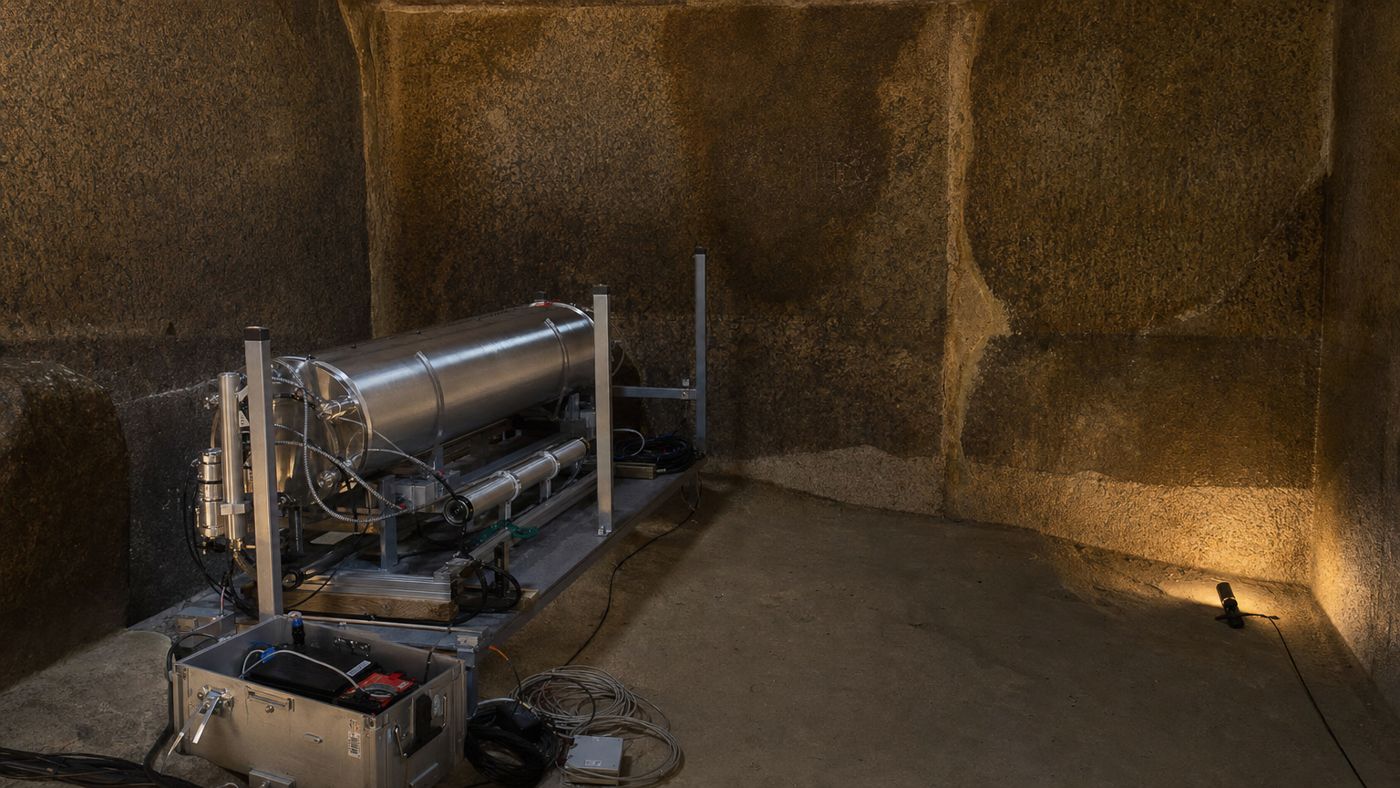
This gives us a measurement principle of stunning simplicity. You place detectors in existing chambers and passages, count for months how many muons come from which direction, and compare that with the expectation for solid masonry. If more arrive from one direction than expected, there is less material there. A void thus casts a shadow in the opposite direction.
This is backed up by diversity. Several types of detectors are used, based on different physical principles: films in which particle tracks become chemically visible, electronic counting arrangements made of scintillators, and gas-filled chambers. They were operated by different institutes, evaluated independently, and only then compared. If three types at three locations show the same anomaly, a device error is practically ruled out as an explanation.
The price for this is time. A reliable measurement takes months, and the resolution is sufficient to recognize a room, but not to say what is in it. That is exactly why the findings are worded cautiously, and that is exactly why they are called voids and not chambers.



Guided day tour with option to visit the interior
- The Grand Gallery is the room above which the large void lies
- Interior access to the Great Pyramid of Khufu can be booked as an add-on
- Plateau entrance, German-speaking guide, pickup, and lunch are included
- Free cancellation up to 24 hours before start
Two Findings That Passed the Test
Two findings have passed the test, and they are understood to very different degrees.
The first is a large void above the Grand Gallery, published in 2017. Measurements from three types of detectors at different locations independently arrived at the same result: above the gallery lies a space at least thirty meters long. Whether it runs horizontally or at an angle, whether it is a single room or a chain of smaller ones, remained open. The publication about it explicitly describes it as a void without any statement about its function or contents.
The second finding is now the better documented one. Behind the angled blocks above the original entrance on the north side lies a corridor about nine meters long. It became visible in the data from 2016, was described in more detail in 2023, and was confirmed in a peer-reviewed paper in 2025.
What is interesting is how this confirmation came about, because it shows what is possible without damage. Three independent methods were used, along with their image fusion: radar measurements at the pyramids of Giza in the form of ground-penetrating radar, ultrasound, and electrical resistivity tomography. All three recorded the same outline. In addition, an endoscope with a diameter of six millimeters was pushed through an existing joint between two blocks. This was the first time the space had been seen in four and a half thousand years.
What these spaces were for is still not answered. For the corridor on the north side, the sober interpretation is obvious: the angled blocks above direct weight to the sides, and a void behind them reduces the load on the original entrance. Something similar is suspected for the large void above the gallery, with the additional possibility that it is the remains of an abandoned construction phase. Both are structural explanations, and both are unproven. What is certain is the existence, not the purpose.
What the camera showed was unspectacular and important at the same time: an empty corridor with a rough floor and a corbelled vault. No grave goods, no inscriptions, no sarcophagus.
The Two Findings in Numbers
- Large void, length
- at least 30 m
- Large void, location
- above the Grand Gallery
- Large void, status
- proven, never seen
- North corridor, length
- approx. 9 m
- North corridor, location
- behind the chevron blocks on the north side
- North corridor, status
- confirmed and seen via endoscope, empty
The Radar Report of 2025
In March 2025, a completely different report went around the world, and it is a lesson in itself.
A group claimed to have found an extensive complex under the middle structure using satellite radar: several identical structures at the base, connected by paths, plus vertical shafts said to extend several hundred meters deep. The figures were announced at a press conference and spread within days across news sites and social networks.
What was missing was the publication. To this day, no peer-reviewed paper exists to support these results, and the method used is unsuitable for this purpose: the process evaluates satellite radar that scans the Earth's surface and penetrates a few meters into dry soil, not several hundred. Independent checks of the claim concluded that there is no sound basis.
Addendum, August 2026: The paper in which the same group described its radar method in 2022 was withdrawn by the journal on August 10, 2026. After a review, the editors cite serious methodological deficiencies and statistical errors; the authors dispute the decision. This also removes the methodological basis for the 2025 claims.
It is remarkable who contradicted them. Not only European and American experts, but also the Egyptian antiquities administration itself publicly stated that there is no scientific basis for columned halls under the middle structure, and that no mission is currently working there.
Why such things catch on anyway has little to do with Egypt. A number like six hundred and forty-eight meters deep sounds precise and is therefore more convincing than a cautious technical formulation with a margin of error. Add to that the fact that the serious findings themselves are astonishing: anyone who has read that an unknown void was actually proven in 2017 will find the next report plausible. The real finds make the false ones credible.
The case shows the pattern that recurs with this topic. A press conference replaces a publication, a large number replaces an error margin, and the reporting takes over both without question. Anyone who wants to classify reports about this structure therefore only needs one question: Where is the data?
Four Common Claims
- True
Unknown voids have been detected in the Great Pyramid of Khufu.
Two, both published in peer-reviewed journals, one of which has since been seen with a camera.
- False
The voids contain treasures or an undisturbed burial.
The corridor that was inspected is empty. There is no statement about the contents of the second void.
- False
There is a huge underground complex beneath the site.
The 2025 claim is not based on any published measurement, and the method cited does not reach those depths.
- False
The pyramid was X-rayed.
X-rays do not penetrate meters of limestone. Muons from cosmic radiation are used instead.
What Has Been Announced Next
The question remains as to what happens next, and caution is advised here.
In November 2025, a prominent Egyptian excavator announced at a book fair that a discovery would be presented in 2026 that would open a new chapter. It was reported that a robot was standing in front of a sealed stone door at the end of a corridor. There is no scientific publication on this, and the wording comes from a lecture, not a peer-reviewed journal.
That doesn't have to be wrong. Announcements of this kind have in the past both been confirmed and come to nothing. Treat it for what it is: a statement of intent from a single person, not a publication. If a door is actually opened, it will not go unnoticed.
A different scenario is more realistic. Both known voids were found using non-destructive methods, and the same methods can be used to find more. The next step is therefore likely not an opened door, but a better map: higher resolution, more measurement points, more precise outlines.
For readers, there is a simple distinguishing feature that requires no specialist knowledge. A peer-reviewed publication always names three things: the method used, the margin of error of the measurement, and the names of the institutes involved. If one of these is missing, it is an announcement, not a result. This check takes thirty seconds and reliably filters out most reports about this structure.
And even if a room were opened, expectations should be tempered. The structure was emptied in antiquity, broken into in the Middle Ages, and has been examined hundreds of times since. An untouched room with contents would be a sensation precisely because it contradicts everything found so far.
Frequently asked questions
Are there chambers under the pyramids of Giza?
Beneath the Great Pyramid of Khufu lies an unfinished rock chamber that has been known and documented for a long time. There is no published evidence of any other underground structures.
Can you visit the voids?
No. Both are inaccessible from the accessible passages. The north corridor was only viewed with a six-millimeter-thin endoscope through a joint.
Why not just drill?
Because the structure is a World Heritage Site and any drilling would be an irreversible intervention. Non-destructive methods and endoscopes through existing joints are permitted.
How long does such a measurement take?
Months. Muons arrive in limited numbers, and only over long periods does a difference become statistically reliable.
Was anything found in the voids?
Nothing in the north corridor: rough walls, a corbelled vault, no grave goods. There are no images of the large void and no statement about its contents.
Plateau entrance as a QR code on your phone
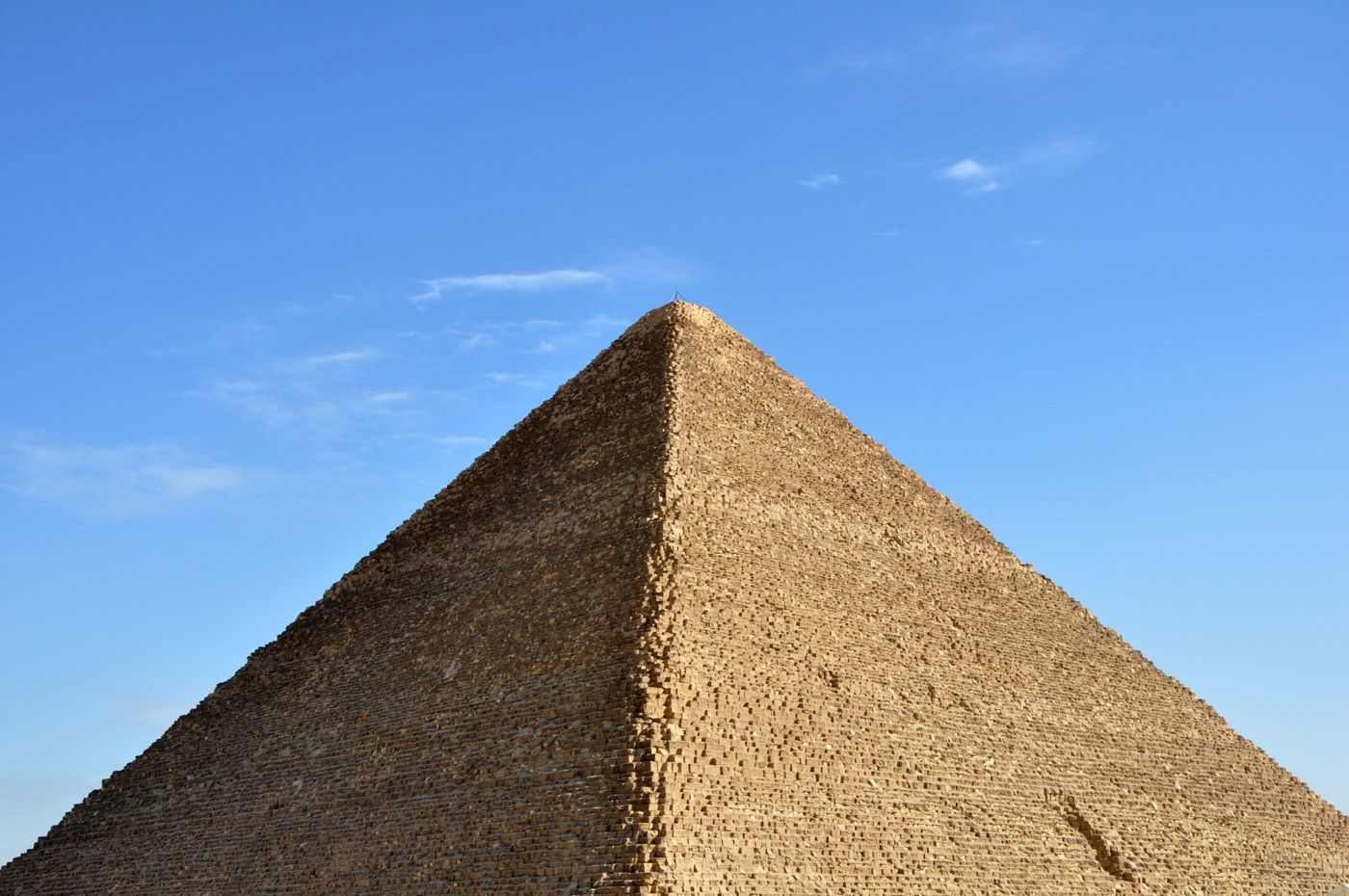
Only one spot is visible from all this: the angled chevron blocks on the north side, behind which the confirmed corridor lies. They are in the regular ticket area.