What to wear for the Pyramids of Giza? Behind this question there is almost always a second one: Is there a dress code?
The answer is no. The Giza Plateau is an archaeological site, not a religious place. There is no rule about covering shoulders or knees, nobody will turn you away at the gate, and the official site overview has no such regulation. The travel advice from the German Foreign Office also contains no dress code for Egypt. If you later want to visit a mosque, you will need to cover shoulders and knees there, but that is a different question and a different place.
So clothing for the Pyramids of Giza is not a matter of decency, but of sun protection. What decides the choice has to do with climate and terrain, not with custom. And the result contradicts the common idea of desert clothing: long and light beats short and airy, and by a clear margin.
What works
- Long, loose trousers made of thin fabric instead of shorts
- Long-sleeved, light top in a light color
- Headwear with a full brim, not a cap
- Sunglasses, because the bright sand reflects from below
- Closed, comfortable shoes that don't mind sand
- A thin scarf for wind, dust, and neck protection
- A light jacket if you arrive in winter at opening time
Why long clothing is better
The reason for the long option is the sun, and it hits twice. From above it comes anyway, and on the site there is no shade between the monuments. From below it comes back, because bright sand reflects a significant part of the light. So you get radiation on areas that usually never see sun: under the chin, on the forearms, behind the knees.
A thin fabric over the skin is more effective here than sunscreen, because it doesn't rub off and doesn't need to be reapplied. The same layer helps against the second point: dust. The fine sand is everywhere, it settles in skin folds and is kept in motion by the wind.
The third factor is the temperature difference. Between day and night in Giza there are about ten degrees all year round. In winter this means: at eight o'clock at the gate it is noticeably cool, and by eleven the jacket gets in the way. If you come at opening time, i.e. the best time, you need a layer that can be taken off and stowed away. In high summer this point falls away, because it is already warm in the morning.
Hat with brim and light long layer
The three things that really make a difference at this place are headwear with a full brim, a thin long-sleeved top, and high sun protection. All three can be bought before the trip and are hard to find on site.
Hiking boots are the wrong advice
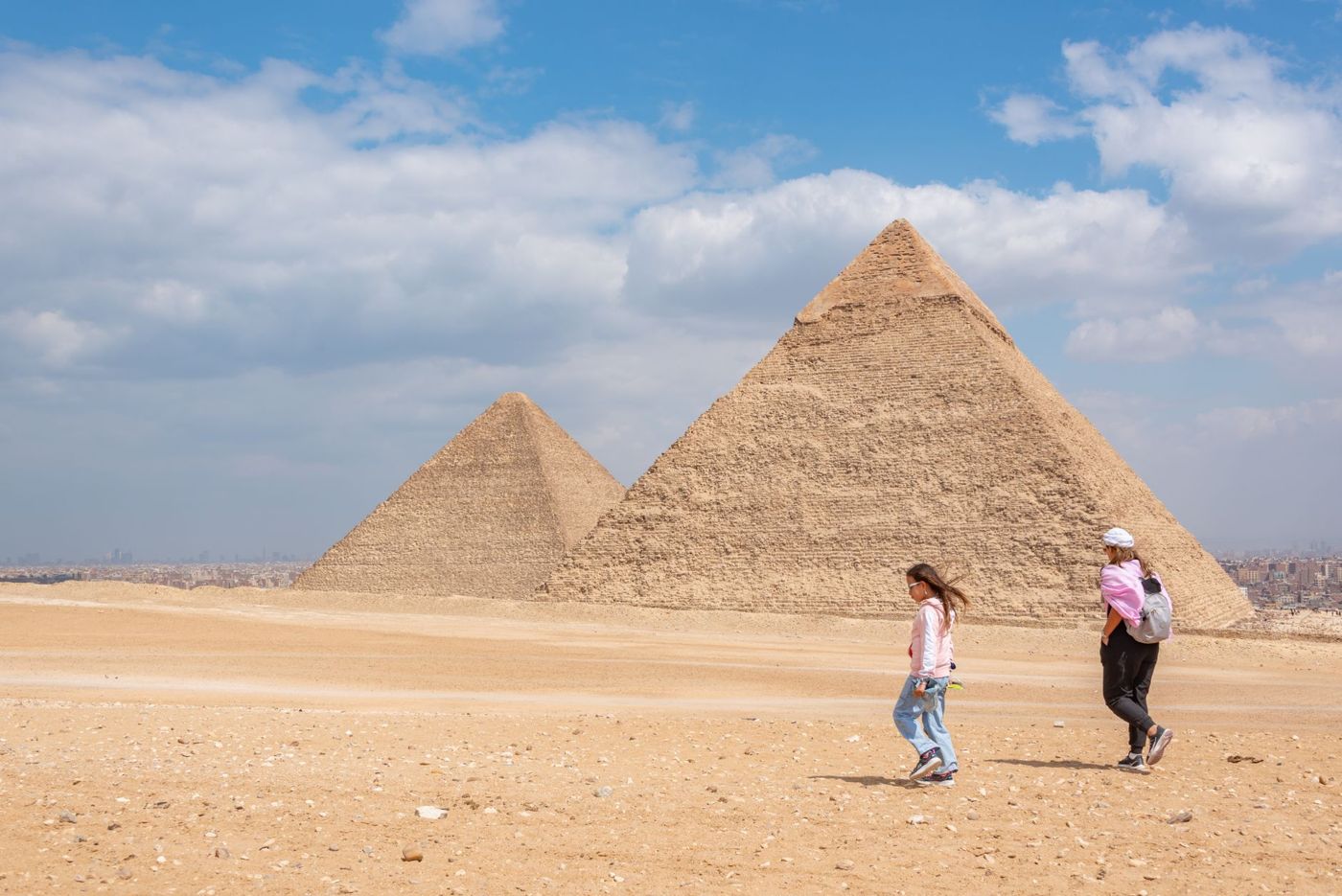
That leaves the question of shoes, and there is a persistent piece of advice: sturdy hiking boots. That is wrong. On the site you walk on soft sand and smooth stone slabs, not on scree, and heavy boots make the heat worse without doing anything. Comfortable closed shoes are sufficient. Sandals work in principle too, but they fill up with sand reliably, and hot stone slabs under bare toes are unpleasant.
For the interior of a structure, an additional requirement comes into play, and it goes in the other direction. The climb in the largest pyramid is narrow, steep, and explicitly hot and stuffy. What you need there is as little as possible: no long jacket, no big backpack, nothing that can get caught. If you plan to go inside, you should leave the extra layer outside or be able to stow it in a small bag.
That basically settles the clothing for a visit to the Pyramids of Giza. What you can leave at home: anything new in white, because dust clings to it, anything with heels, anything tight, and the idea that you have to cover up here. You don't have to. You do it because the sun comes from two sides.
Frequently asked questions
Do women have to cover shoulders and knees?
Not on the plateau. There is no dress code. In a mosque there is, but that is a different place.
Are shorts okay?
Allowed yes, sensible rather not. Thin long trousers protect better against sun and dust and attract less attention on site.
Do you need hiking shoes?
No. Sand and stone slabs, no scree. Comfortable closed shoes are enough, heavy boots rather harm.
What do you wear in winter?
The same, plus a light jacket for the first hour. The difference between early and midday is about ten degrees.
What do you wear inside a pyramid?
As little as possible. It is hot and stuffy there, the passage is narrow, and anything bulky gets in the way.