Is a visit to the Pyramids of Giza safe? The answer is yes, but it deserves more than a single word because the question usually arises from a mix-up.
Two things are mixed up: Egypt as a country and the Giza Plateau as a place. For Egypt, there is indeed a partial travel warning from the Federal Foreign Office, and it is meant seriously. However, it concerns regions that are several hundred kilometers away from Cairo, and it does not include the capital or the plateau.
A comparison of sizes helps: Egypt is almost three times as large as Germany. A warning for North Sinai says about as much about Giza as a note about a remote border region says about a country's capital.
This distinction is the whole answer. Those who know it can classify the reports they read about Egypt and do not have to guess whether they affect them.
In addition, there is a second level that is less dramatic but practically more important: What can actually go wrong at the plateau is rarely dangerous and mostly annoying. This page also deals with that.
- Official classification
- Partial travel warning for certain regions, not for Cairo and Giza
- Crime
- According to official information, comparatively low, with high police presence
- Terrorism
- Country-wide residual risk, as in many travel destinations
- Real at the plateau
- Sales pressure, overpriced rides, heat
- Medical
- Treatment is paid in advance, insurance strongly recommended
- Complaints
- Central office set up at the site
What the Federal Foreign Office actually says
In order, and with the source that matters for German travelers. The Travel and Safety Information of the Federal Foreign Office is the authoritative information, it is continuously updated, and it is refreshingly specific.
A partial travel warning exists for the north of the Sinai Peninsula, for the Egyptian-Israeli border area with the exception of Taba, and for remote areas of the Sahara. For the south of the Sinai Peninsula, unaccompanied excursions on your own are advised against. The border regions to Libya and Sudan have been declared restricted areas by the Egyptian authorities.
Regarding the term itself, because it is regularly misunderstood: A travel warning is not a ban. It is the clearest form of official recommendation, and ultimately the traveler must decide. With a partial travel warning, the first word matters: It names regions, not a country. Therefore, when reading it, it makes sense to look at the map first and then at the word warning.
Cairo and Giza do not appear in this list. The domestic political situation is described as tense but stable, and for the whole country, a residual risk of terrorist attacks is pointed out, as is the case in many travel advisories.
One sentence is remarkable, which many do not expect: The crime rate in Egypt is comparatively low, also because of a high police presence in many places. This matches what visitors experience at the plateau, where tourist police are visibly on duty and entry is through a security check.
Why travel insurance here is more than a formality
- In Egypt, treatment is usually paid in advance and only reimbursed afterwards
- The realistic cases are circulation and heat, not accidents: two kilometers without shade take their toll
- The narrow, steep ascent inside a pyramid is a real strain on circulation and knees
- Emergency call, medical chat, and claims reporting work via the app, which makes the difference abroad
Where the warning applies and where it does not
The distances are the real point. What applies to North Sinai says as little about Giza as a warning for Eastern Anatolia says about Istanbul.
| Area | Official classification | Distance from Giza |
|---|---|---|
| Giza and Cairo | No travel warning | the place itself |
| North Sinai | Partial travel warning | several hundred kilometers northeast |
| Egyptian-Israeli border area, except Taba | Partial travel warning | several hundred kilometers east |
| Remote Sahara areas | Partial travel warning | west, off any travel route |
| South Sinai with Sharm el-Sheikh | Solo excursions advised against | flight distance, common beach destination |
| Border areas to Libya and Sudan | Declared restricted areas by the authorities | far away, not travelable |
- Official classification
- No travel warning
- Distance from Giza
- the place itself
- Official classification
- Partial travel warning
- Distance from Giza
- several hundred kilometers northeast
- Official classification
- Partial travel warning
- Distance from Giza
- several hundred kilometers east
- Official classification
- Partial travel warning
- Distance from Giza
- west, off any travel route
- Official classification
- Solo excursions advised against
- Distance from Giza
- flight distance, common beach destination
- Official classification
- Declared restricted areas by the authorities
- Distance from Giza
- far away, not travelable
Status of the information at the time of review. Travel advisories change, and for your own trip, the wording on the day of travel always applies, not the summary on a website.
What really happens at the plateau
Now to the second level, which is more important for the day on site. What actually happens at the plateau does not appear in any security alert because it is not a security issue.
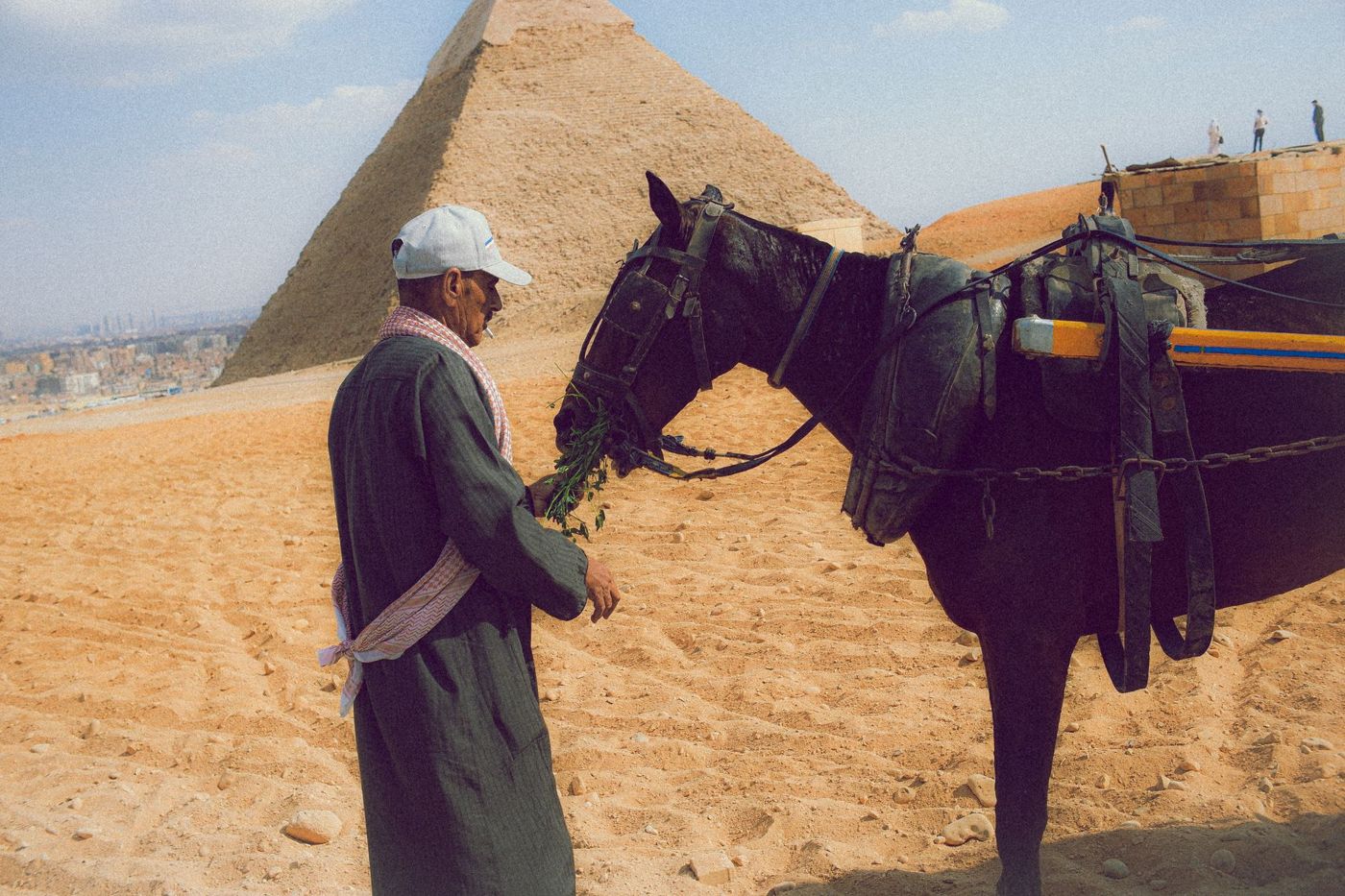
First and foremost is sales pressure. Carriage rides, camel rides, souvenirs, alleged guided tours, the photo with your own phone for which money is then demanded. That is unpleasant, persistent, and according to the evaluated visitor feedback, by far the most common criticism. It is not dangerous. A friendly, repeated no is enough, and if you do not take anything in hand, you do not owe anything.
Second are overpriced rides. The classic variant is the return trip: You come out at a gate where your driver is not standing, and you negotiate in the heat with someone who knows your situation.
Third is the heat, and it is the only real health risk of this place. Two kilometers without shade, bright sand that reflects the sun, and people who drink too little because they underestimate the morning.
And a fourth thing should be mentioned because it does not appear in any security debate and yet represents the greatest everyday risk: road traffic. Whoever crosses a street in Giza deals with traffic that follows different rules than the zebra crossing. This mainly affects the way from the eastern gate to the neighborhood and back. The simplest solution is to stick with locals and cross together with them.
For complaints about providers, there has been a central office at the site since the reorganization, reachable under the short number 19349. That it exists is itself an indication of how the problem is classified, namely as an operational disruption and not as crime.
Why the concern persists
The question remains why the concern is so persistent, and the answer lies in the internet archive.
If you look up how safe Giza is for tourists, you will reliably come across a warning from the American embassy that advised against the plateau. It is real. However, it dates from 2013, from the months after the revolution, and described a site without visible police presence where vehicles were surrounded. The Egyptian side called the warning unfounded at the time. Whoever comes across it today reads a document about a country in a different situation.
This is exactly how you can show how to read security information: date first, region second, source third. A text without a date is worthless. A text about another governorate says nothing about your travel destination. And a summary on some website does not replace the official wording, which you can read yourself in two minutes.
Moreover, the site itself has changed. The old gate was closed, among other things, due to crowding, noise, and harassment, vehicles are no longer allowed in, and access is via a security check. Much of what was complained about in 2013 has been structurally removed.
The same sorting helps with news from the wider region. Egypt borders areas that are widely reported on, and a headline about the Middle East quickly becomes a concern about Cairo. The official advisories explicitly address this situation but still describe the domestic political situation as stable. That is not appeasement but an assessment from the same authority that would change it at any time.
What applies in an emergency should still be known: The German Embassy in Cairo is responsible for consular assistance, and its reachability belongs on the same note as the number of your accommodation.
Cairo Airport: private transfer at a fixed price
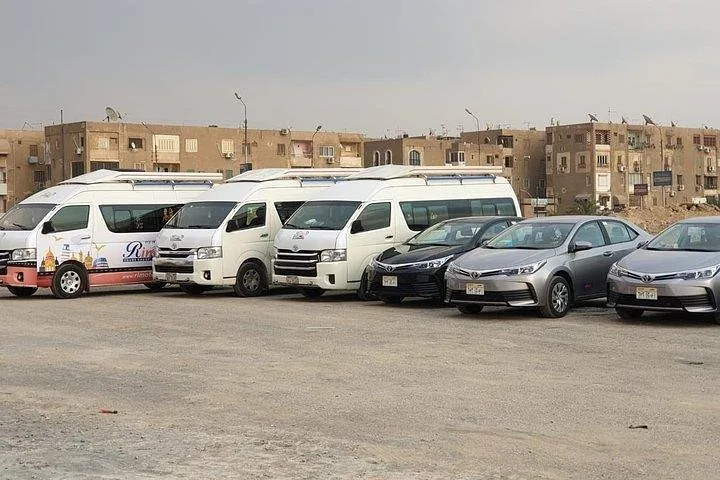
The biggest everyday annoyance at this place is not crime but price negotiation on the street, and you lose it most reliably when tired and after dark. A pre-booked car with a fixed price takes exactly this situation out of the day. Free cancellation, immediate confirmation.
Frequently asked questions
Is there a travel warning for Egypt?
A partial travel warning, specifically for North Sinai, the border area with Israel except Taba, and remote Sahara areas. Cairo and Giza are not affected.
Can a woman go alone?
Yes, and many do. There are own experiences and tips for this, which are on a separate page because they need more space than a line.
Should you take valuables?
As little as possible, as at any heavily visited place. Pickpocketing is the realistic petty crime, not robbery.
Do you need travel insurance?
Strongly recommended. Treatment is usually paid in advance, and the most common cases at this place are circulation problems due to heat.
Is the way inside a pyramid dangerous?
Not dangerous, but strenuous. Narrow, steep, warm, and without the possibility to turn back. If you have heart or knee problems, you better skip it.
What to do if someone persistently demands money?
Refuse politely but firmly, do not accept anything, keep walking. For complaints, there is a central office at the site.