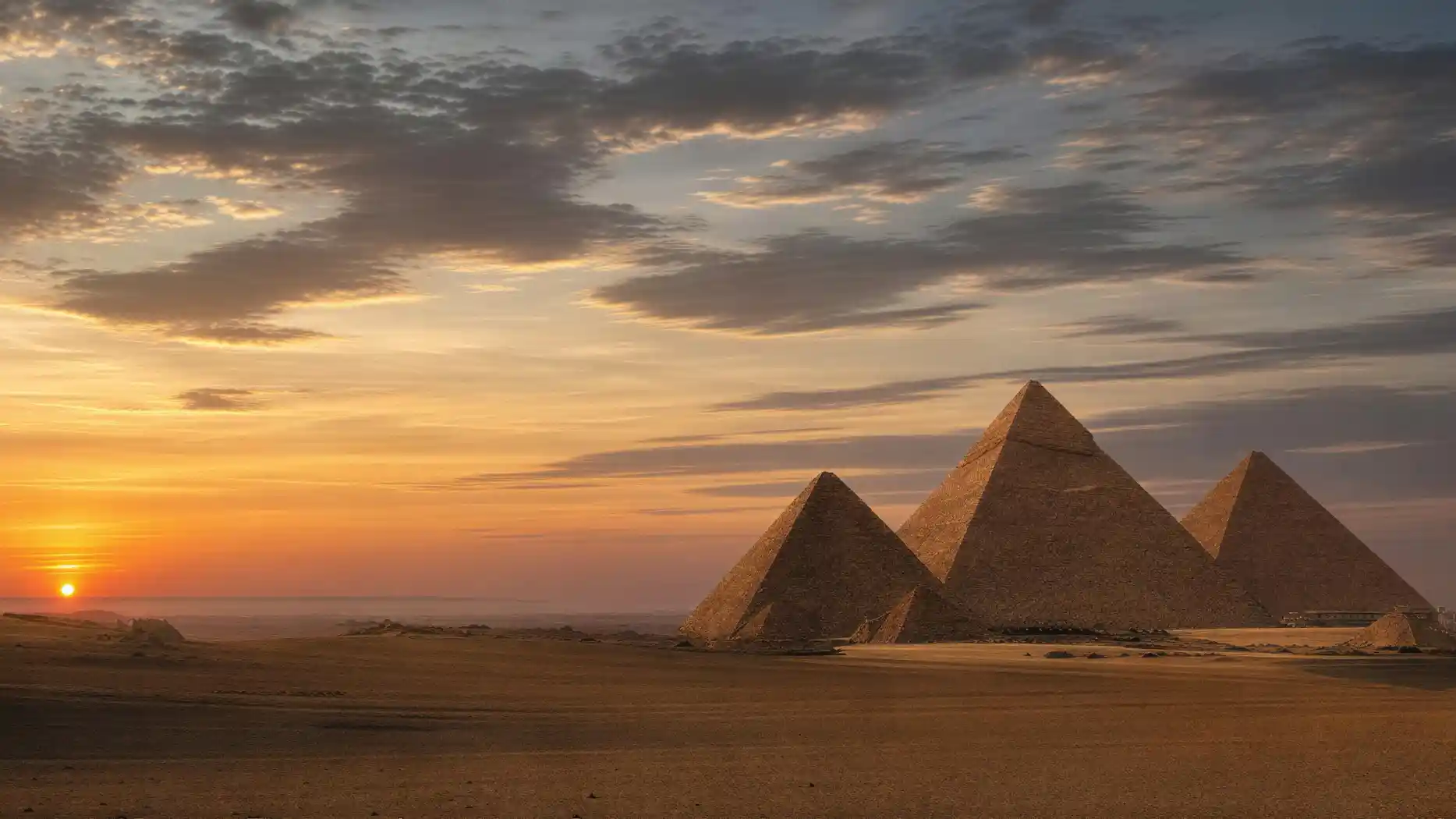
If you search for the phrase 'Sphinx, great pyramids of Giza, pharaohs', you are most likely not looking for travel information but for the answer to a riddle from a mobile game. The answer is Egypt.
That covers the most common reason for visiting this page in one sentence, and the rest can deal with the actually interesting question: why is this site so well suited as a riddle question, as a game setting, as a quote, and as a backdrop for video clips?
The answer has to do with a rare quality. The silhouette is recognizable worldwide, can be drawn in three strokes, and is associated with a single connotation. That makes it the ideal abbreviation: one image conveys a setting, an era, and a mood without explaining a word. Only a few structures achieve that, and even fewer have done so for four and a half millennia.
Economically, that is not insignificant. The silhouette is in the public domain, the motif costs nothing, and it works in every language. For advertising, packaging, and game graphics, that is a rare combination, and it explains why these three triangles have appeared on cigarette packs, record sleeves, and shop signs for over a hundred years, often with no connection to the content.
This page covers the main forms: the timeline of popular images, the role in video games including a case where a game became teaching material, the most famous quotes with their attribution problems, and finally the spread through social networks.
The Pyramids in Popular Culture
- 1798
Napoleon speaks to his soldiers before the Battle of the Pyramids. The phrase about the forty centuries becomes the most quoted saying about the site.
- 1876
First verifiable print of the phrase stating that man fears time, but time fears the pyramids. Passed off as an Arabic proverb, without a traceable origin.
- 1922
The discovery of Tutankhamun's tomb triggers a worldwide Egyptomania affecting fashion, architecture, and advertising; its imagery is still influential today.
- 1999
A well-known adventure game sets multiple chapters on the plateau, making it accessible to a whole generation of gamers.
- 2018
A major game title introduces a non-violent educational mode with 75 guided tours curated by historians and Egyptologists.
- 2024
A high-reach video clip claims that the pyramids were rented for 100 hours. The authority publicly contradicts this.
28.1. Four Roles in Computer Games
In video games, since the 1990s, the plateau has appeared in three recurring roles. As the scene of an adventure, with traps, corridors, and a chamber at the end. As a construction project in building games, where the player organizes work crews and builds ramps. And as a structure in strategy games, where it gives advantages as a unique building and usually comes with high costs. These roles represent different ideas: the tomb as a hazardous space, the construction as an administrative task, and the building as a prestige object.
The most interesting case stands in the middle of this list and is rarely mentioned because it contradicts the stereotype of gaming as a pastime.
In 2018, a French game developer released a dedicated educational mode for its Egypt title. It makes the whole game world accessible, but without combat, enemies, or objectives. Instead, 75 themed tours lead through the world, curated by historians and Egyptologists, covering the plateau, mummification, and the daily lives of the builders.
The result is remarkable. The mode was used in schools, and a companion study compared learning outcomes to traditional teaching. They reported a gain of about 44 percent among students who worked with the game, compared to about 51 percent for those taught by a teacher. That is not proof that games can replace lessons, but a remarkably small difference.
For travelers, this mode has a practical side effect that is little known: if you walk around in it for an hour, you have the layout of the buildings in your head, know the names of the annexes, and know how long the paths are. That is more spatial preparation than most travel guides provide, and it costs nothing but time. The mode does not show the current state of the site: it shows a reconstructed antiquity, not an excavation site with fences, access roads, and souvenir stalls.
Experts have mostly praised the implementation while stressing where gaps were filled with design. That is the honest approach: a reconstruction is a claim about a state, and where evidence is missing, design decides. If you know it, you can get a lot out of such worlds.
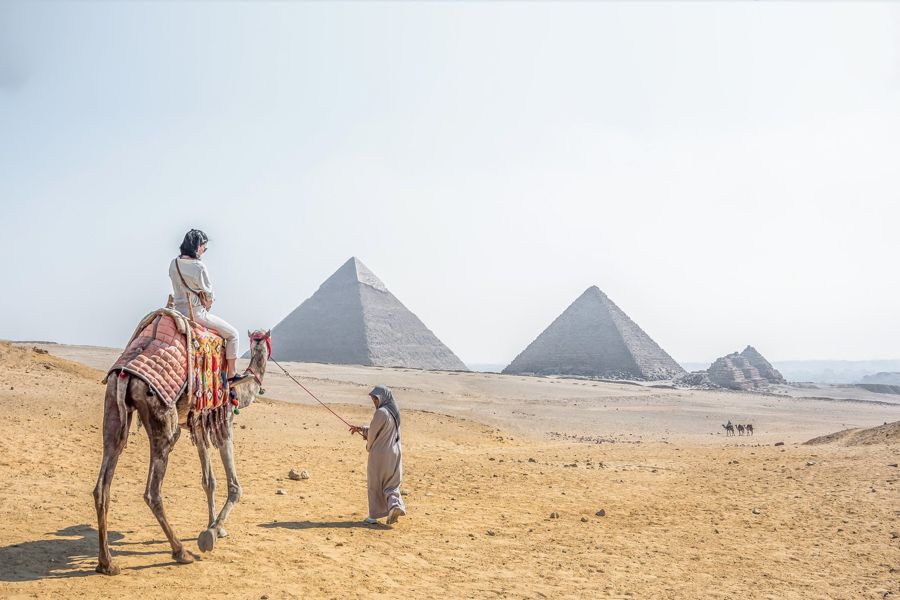
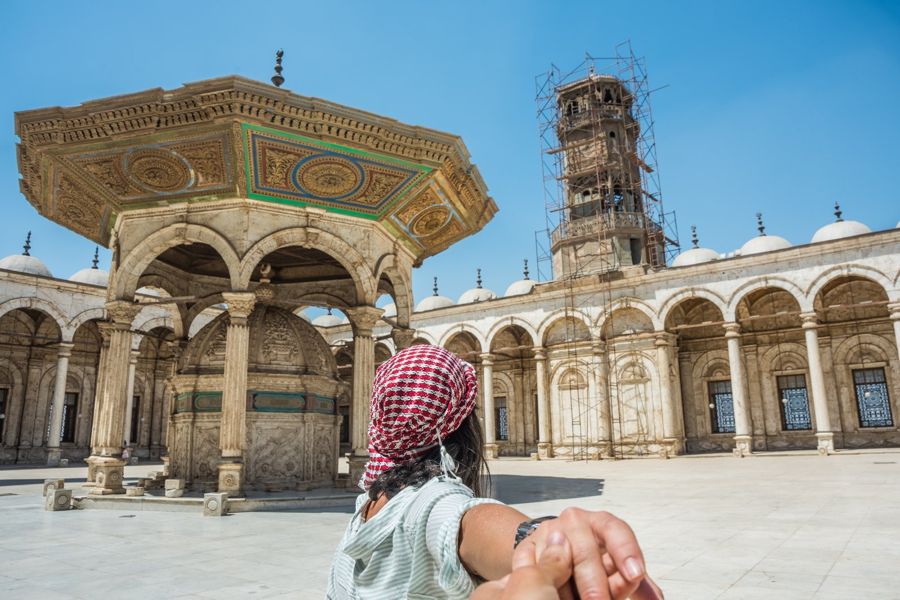
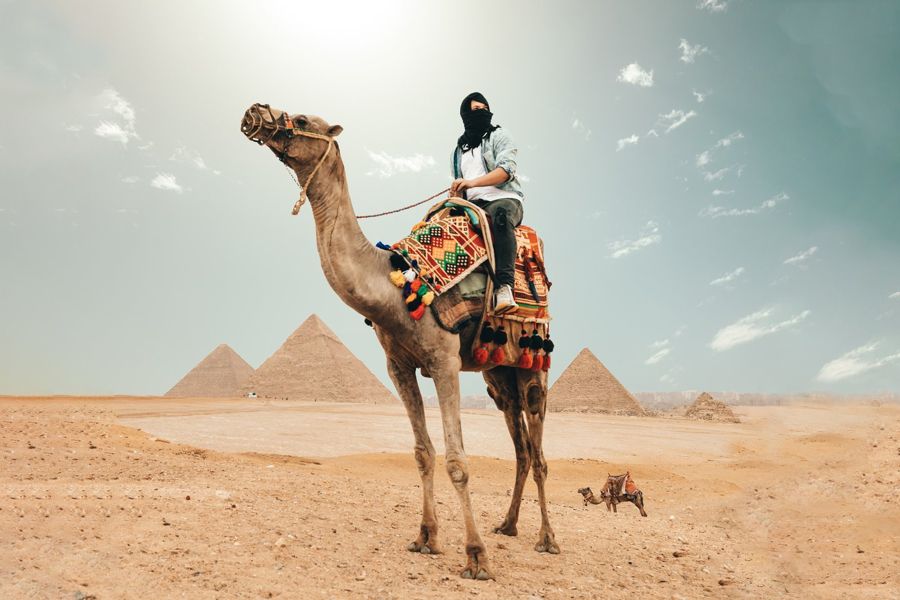

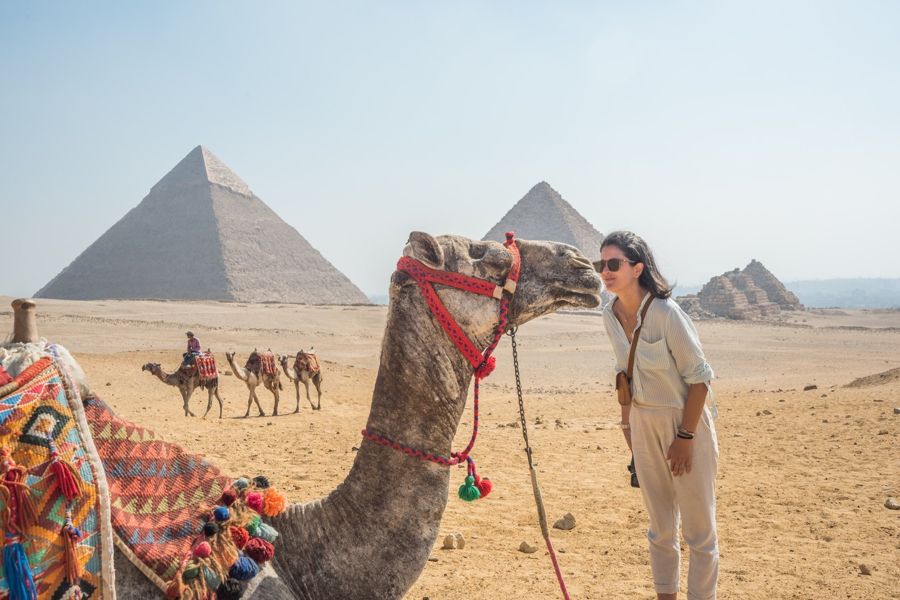
A day between the plateau, the Citadel, and the Bazaar
- The setting once without a screen: eight hours with German-speaking guide
- Pickup and plateau entry included per provider
- Access to the interior of the pyramids is expressly not included in this offer
- Free cancellation up to 24 hours in advance per provider
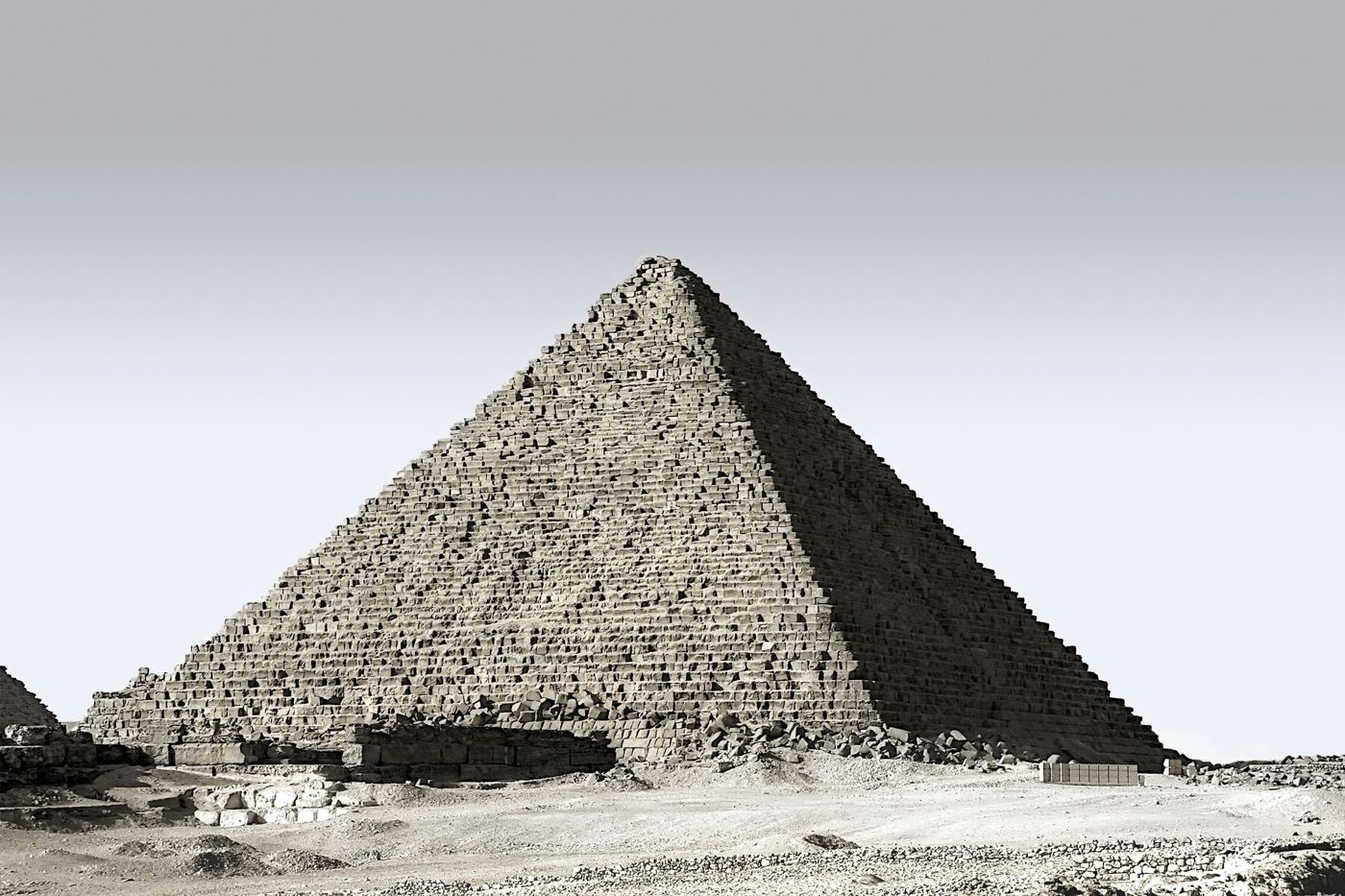
Two Famous Quotes with Problematic Origins
Let’s move to the words. There is no lack of quotes about the Great Pyramids, and the two most famous ones share the problem of provenance.
The first is supposed to come from the Arabic Middle Ages and says that man fears time, but time fears the pyramids. The sentence is great and is everywhere listed as an old proverb. Only its verifiability is lacking: a compilation of proverbs notes that the alleged Arab scholar of the twelfth century was never identified and that the earliest documented version dates from 1876, from a French geography handbook. The sentence about durability is thus itself a young invention.
The history of its influence is also curious. The sentence appears today in travel catalogues, on postcards, and in speeches, usually with the phrase “an old Arabic proverb,” and it is precisely that that makes it valuable: it lends age and distance. A sentence from a 19th-century French geography book would not have that effect, even though it would be the same sentence.
The second, better documented quote, stands precariously: before the Battle of the Pyramids in July 1798, Napoleon is said to have called out to his soldiers that from the top of those pyramids, forty centuries looked down upon them. The wording varies widely among sources. And the battle took place so far from the pyramids that they might only have been seen on the horizon at best.
A third category are sentences that do not achieve the rank of quotes, but already work as an image. The discovery of Tutankhamun’s tomb in 1922 triggered a wave that swept through fashion, furniture, cinema architecture, and advertising design, and from that time a large part of the design that is still perceived as “ancient Egyptian” – often it is 1920s style, not antiquity. Look at old advertising posters with pyramids and you see more of the interwar period than of the Old Kingdom.
Both cases show the same thing: a good quote about this place gets through because it is good, not because it is backed by evidence. If you want to use one, you are well advised to label it as an attribution.
Language: A Simple Distinction
Finally, the language is as important as the landscape. The pyramid is a conversational devise. The grammar does not matter; the re, and also helps you. This even, the above.….
The original beyond the screen. For those who know the site only from a game, a visit compares to a contrast: scale and terrain cannot be rendered – it deserves more than a rushed morning. Three houses that cover that:
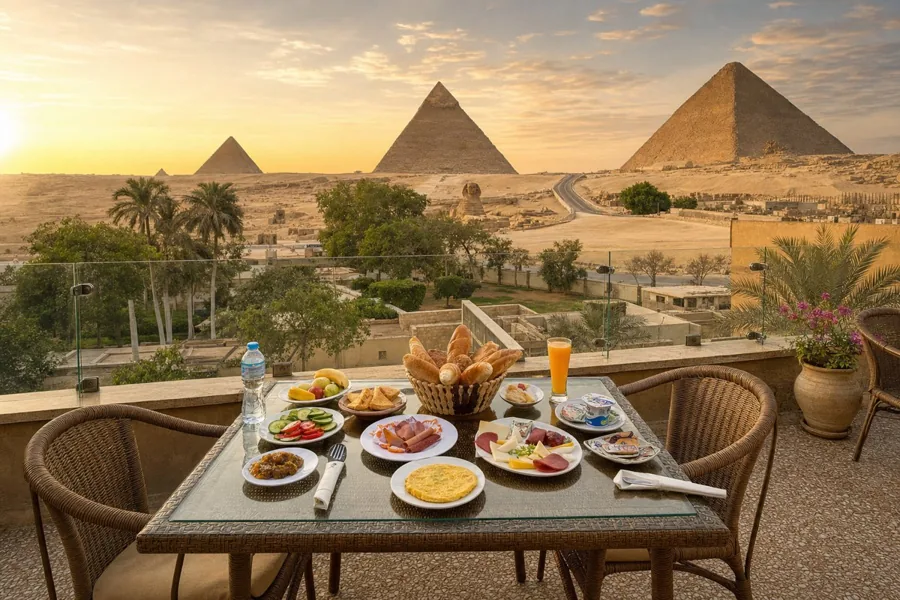 At the Sphinx
Giza Pyramids View Inn
- Good breakfast
- Airport shuttle
- Two restaurants
- 24-hour reception
- Free Wi-Fi
For those who want to see the Sphinx from their breakfast chair
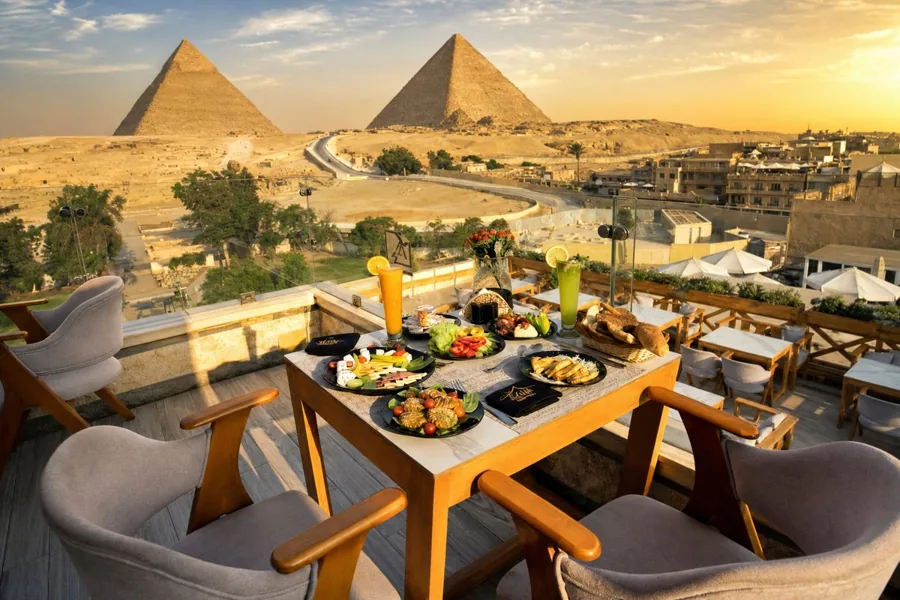 Most reviewed
Great Pyramid Inn
- Fabulous breakfast
- Rooftop terrace restaurant
- Bar
- Airport shuttle
- 24-hour reception
Most who want to stay in the neighborhood
 Garden & pool
Marriott Mena House
- Excellent breakfast
- Outdoor pool
- Spa and wellness center
- Three restaurants
- Fitness center
For those who want space, garden, and pool instead of a rooftop terrace
Frequently asked questions
What is the answer to the riddle?
Egypt. The question asks for the country associated with the Sphinx, the pyramids, and the pharaohs.
In which games does the site appear?
In numerous ones, from building games to adventure titles to big open-world productions. The famous case is an Egypt title from 2017, which received its own educational mode in 2018.
Is the quote about time fearing the pyramids true?
As a proverb, it is not proven: the alleged Arab author has never been identified, and the earliest verifiable version comes from 1876.
Did Napoleon actually say the phrase about the forty centuries?
Probably in some form; the wording varies wildly among sources. Moreover, the battle took place so far that the pyramids were barely visible.
Were the pyramids really rented for a video?
No. The authority clarified that they were filmed outside operating hours, the area remained accessible, and no rental occurred.
Are games useful preparation for a visit?
Yes, for layout, distances, and scale. Not for the condition, because reconstructions show the buildings with the cladding, which no longer exists since the Middle Ages.