Almost everyone knows the Pyramids of Giza at night, but almost no one has seen them that way themselves. The reason is not written on any ticket, but it follows from it: the site closes in the late afternoon, long before it gets dark. Anyone who looks after nightfall stands outside the fence.
That is the most important piece of information on this page. The second follows immediately: what can be seen in the dark at all depends not on the moon, but on spotlights. Without artificial light, the structures would be black shapes against a sky that is significantly brighter than most expect. That very sky is the surprising part of the story, and it is surprisingly well measured.
The Light Belongs to the Evening Show
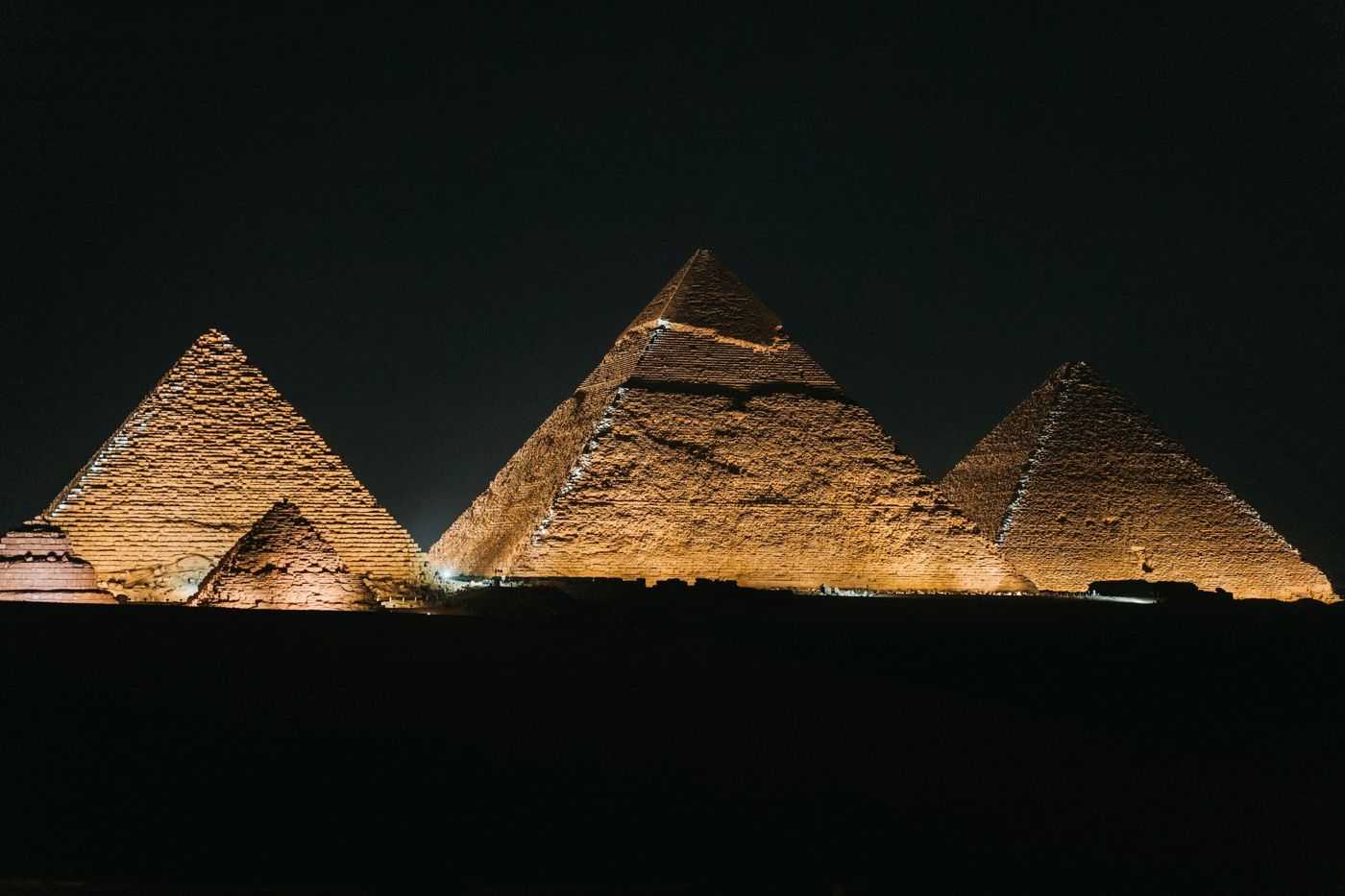
The light that makes the structures visible in the evening does not belong to the site, but to the sound and light show. Behind it is a system of spotlights and a speaker's voice that is about forty years old, not a projection onto the surfaces and not a permanent illumination like European landmarks have every night.
For the evening, this has a consequence that is rarely written anywhere: whether the pyramids glow depends on the schedule. The system is currently being renewed, performances are canceled at short notice, and how the operation runs on a particular evening can only be clarified on a daily basis. The show continues during the renovation, but can also be canceled at short notice. If there is no show, it stays dark, and an evening that had counted on the illuminated structure comes up empty.
The light is also colored. The system works with colored spotlights, which is why the same pyramid can look completely different in two photos without anyone having touched it up. And the moon helps less than many assume: it casts shadows, but provides a flat, colorless light and is not in the right position every evening.
Accommodations with a clear view of the illuminated site. The rooftop terrace is the only place in the evening where you are not bound by time. Three houses that cover this:
 At the Sphinx
Giza Pyramids View Inn
- Good breakfast
- Airport shuttle
- Two restaurants
- 24-hour reception
- Free Wi-Fi
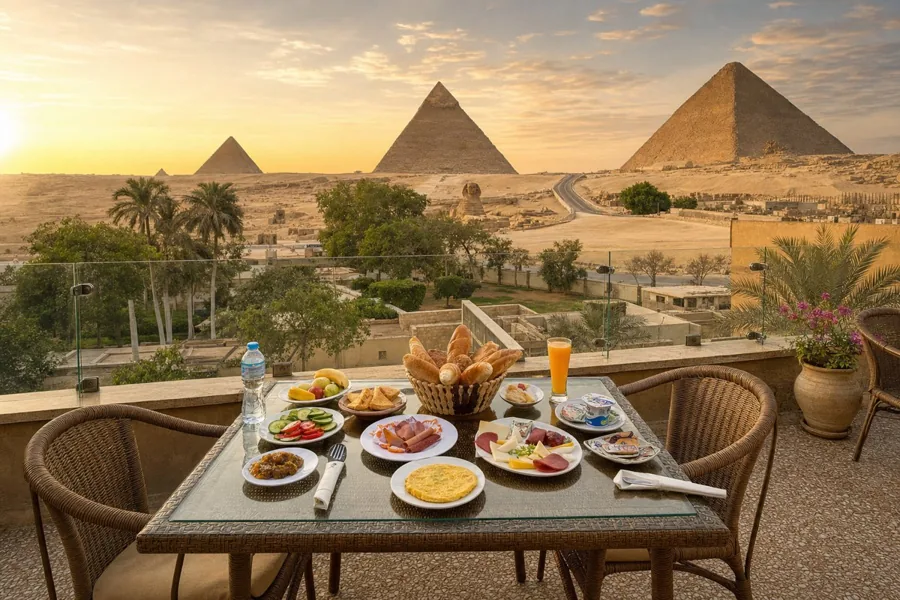
For those who want to see the Sphinx from their breakfast chair
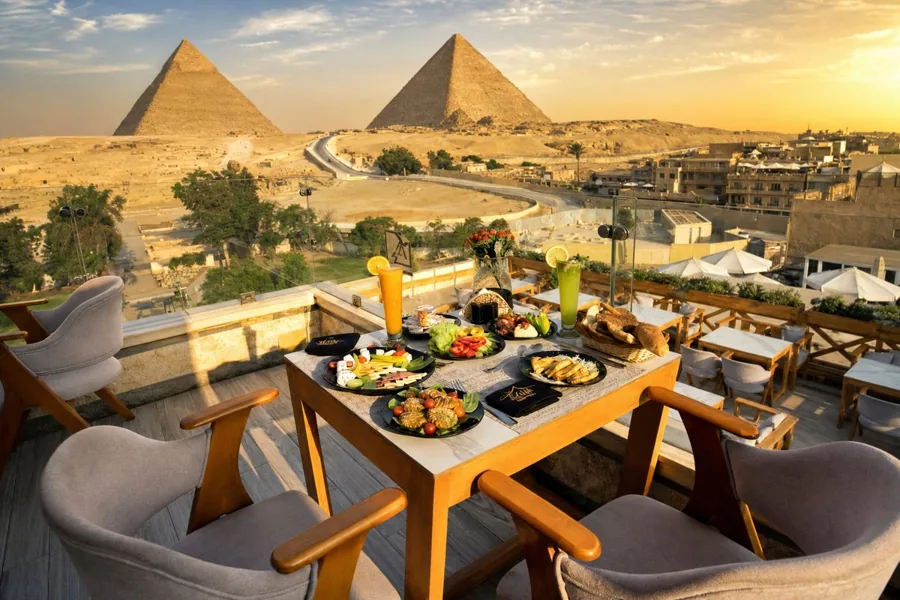 Most reviewed
Great Pyramid Inn
- Fabulous breakfast
- Rooftop terrace restaurant
- Bar
- Airport shuttle
- 24-hour reception
Most who want to stay in the neighborhood
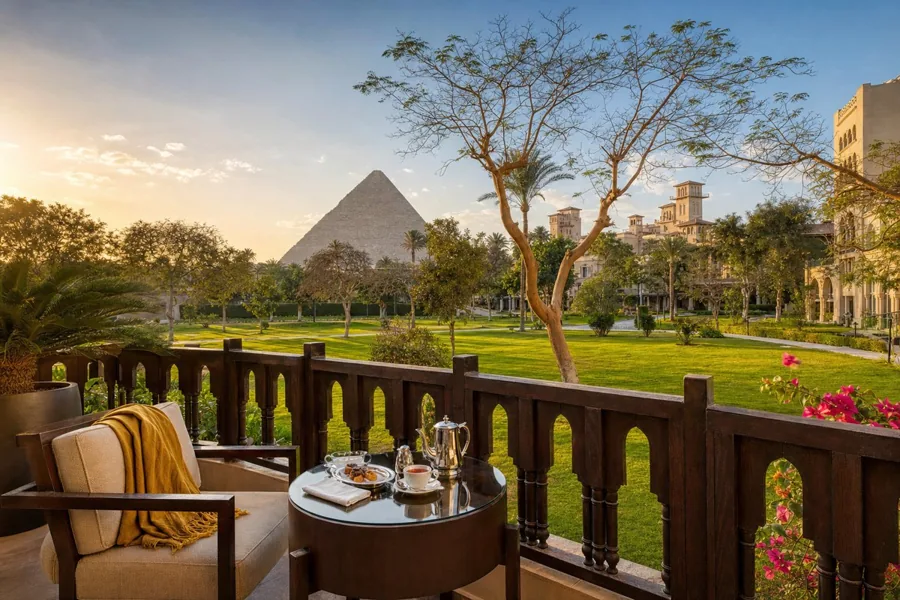 Garden & pool
Marriott Mena House
- Excellent breakfast
- Outdoor pool
- Spa and wellness center
- Three restaurants
- Fitness center
For those who want space, garden, and pool instead of a rooftop terrace
Where You Can Stand in the Evening
The question remains where you can stand in the evening at all. Three places come into question, and none of them is a free walk among the structures.
The first is the grandstand of the evening show east of the Sphinx, with its own entrance, fixed seating, and fixed start time. The second is the restaurant complex on the site itself, which now also opens in the evening, with a shuttle from the visitor center and a lit path. This requires a reservation and applies to the terrace, not the excavation site around it. The third place, and for most the realistic one, is the roofs and terraces in the district east of the fence, where guesthouses and restaurants were built precisely for this view.
The difference from the day is greater than it initially sounds. During the day, your location determines how the structures look, whether you get structure in the stone or a silhouette. After nightfall, it determines whether you see them at all.
The Night Sky over Egypt in Numbers
From the world atlas of artificial sky brightness. The values apply to the whole country and show a contrast that explains everything for the evening at the plateau.
| Sky brightness at zenith | Share of population | Share of land area |
|---|---|---|
| Practically unpolluted, up to 1.7 microcandela per square meter | 0.0 percent | 52.4 percent |
| Milky Way no longer visible, above 688 | 97.5 percent | 4.9 percent |
| So bright that the eye no longer adapts to darkness, above 3,000 | 37.1 percent | 0.5 percent |
- Share of population
- 0.0 percent
- Share of land area
- 52.4 percent
- Share of population
- 97.5 percent
- Share of land area
- 4.9 percent
- Share of population
- 37.1 percent
- Share of land area
- 0.5 percent
Falchi et al., Science Advances 2016. The values come from a model based on satellite data, not from measurements at each individual location. More than half of the country's land area has an almost untouched sky, and practically no one lives there.
The Starry Sky in the Photos Is Composite
The same work contains a sentence that belongs exactly here. The world atlas published in 2016 in Science Advances names the place that is furthest in the world from being able to see even a hint of the Milky Way. That place is in the Nile Delta near Cairo. Not Tokyo, not Los Angeles, not the Ruhr area.
So if you see a photo of the Great Pyramid of Khufu at night with a dense starry sky above it, you are usually seeing two photos that have been composited. The sky over the plateau is brownish orange, not black, and it stays that way until morning.
From space, the same thing is visible from the other side. In a night image from the space station from July 2023, the plateau lies as a dark strip between the brightly lit Cairo to the east and the orange satellite cities to the west. That very dark strip is the reason why the structures simply disappear without spotlights.
For your own photo, a simple rule follows: expose for the spotlight light and do not expect to get stars in the same image.
Compact camera support for the terrace
Handheld won't work at this distance and light; on a rooftop outside the site, you don't need a permit for that, unlike inside.
Frequently asked questions
Can you visit the Pyramids of Giza at night?
Not the excavation site. It closes in the late afternoon. In the evening, you can reach the grandstand of the show, the restaurant complex with a reservation, and the terraces outside the fence.
Are the pyramids lit every night?
No. The spotlights belong to the evening show. If it is canceled, which happens during the renovation of the system, the structures remain dark.
Can you see the stars from there?
Hardly. The sky over the plateau is among the brightest in the world. For a dark sky, you have to go far into the desert.
Where do the images with the Milky Way over the pyramids come from?
Almost always from two photos. A starry sky of this kind is physically impossible to photograph at this location.
From which side do you see the illuminated flanks?
From the east, i.e., from the city side. The show takes place on this side, and the lighting is aimed at its audience.