There are no cars on the Giza Plateau, and that is the one change that most reliably surprises returning visitors. If you were there a few years ago, you remember a road running along the foot of the Great Pyramid, tour buses right next to the monument, and taxis driving up to the viewpoint. That is over.
The rule is simple: private vehicles and tour buses are no longer allowed on the site. Your driver drops you off at the gate, stays outside, and picks you up there again. Inside, you move on foot or with the electric shuttles, which are included in the entrance fee.
Two misunderstandings are worth clearing up right away. The ban does not mean you have to walk for miles: the shuttle serves the key points, and it costs nothing extra. And it does not mean you will not see any vehicles at all; on the paths within the site, service vehicles, shuttles, and supervisory vehicles are in operation. What is prohibited is private access, not all traffic.
For planning, this has more consequences than it sounds. It affects where you get off, how you find your driver again, how long you walk, and whether coming with your own car even makes sense.
This page deals with the ban itself: what applies, why it was introduced, how arrival works, which exceptions are reported, and why the new regulation met with mixed reactions on site. The shuttle and the individual gates have their own pages.
Why the ban was introduced
The rule was introduced as part of the reorganization of the entire visitor operation, which went into trial operation in spring 2025.
The rationale has three parts, and all three are understandable. First, traffic: the old gate was in the middle of the city area, and on busy days, feeder traffic backed up into residential streets. Second, exhaust fumes, which are not good for a limestone structure. And third, the impression: a parking lot at the foot of a 4,500-year-old monument is hard to defend once you think about it.
In place of vehicles came a shuttle system with electric buses. According to a report from April 2025, forty-five vehicles were planned, running at intervals of about five minutes, with stops distributed across the site.
The comparison with the previous situation makes the difference clear. Previously, the approach ended practically at the monument, which was convenient but turned the place into a thoroughfare. Today, it ends at a checkpoint, and the walk to the first monument is a deliberate stage. Those who see this as a deterioration use the old state as a benchmark; those who see the site for the first time take it for granted.
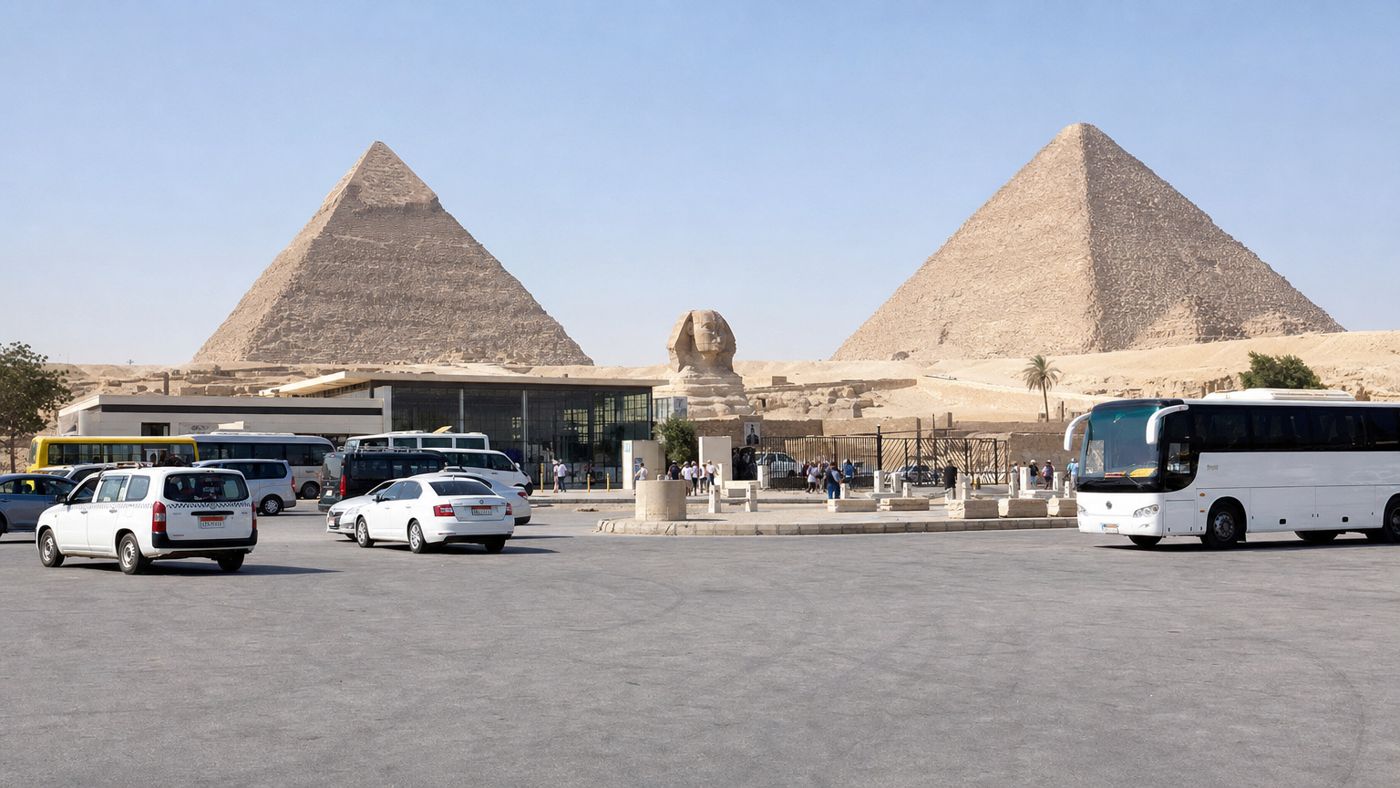
At the new visitor center on the desert road, there is a parking area that also accommodates tour buses. Capacity figures in reports vary, which is why no number is given here; what matters is that you get off there and do not drive further.

Private car with driver, with waiting time at the gate
- Since 2025, private vehicles are not allowed on the site, so the driver waits outside
- That is exactly why the waiting time is the key point: you book the day, not the route
- You can enter at one gate and exit at another without losing your car
- Free cancellation, instant confirmation
Arrival with driver, step by step
- Decide on the gate in advance
The two entrances are far apart. Tell the driver which gate it should be before departure, not on the way.
- Drop-off at the gate
The car stops in front of the entrance. Take everything you need; a second trip to the car is not planned.
- Agree on pickup point and time
Set a specific place and time, preferably with a buffer. Inside the site, the driver is not reachable for you if the network is weak.
- Inside: on foot or by shuttle
The shuttles serve the key points and are included in the ticket. The paths between the stop and the monument remain for you.
- Plan the return trip
From the last stop to the gate and through the checkpoint takes time. Be generous so the driver does not wait in a no-parking zone.
The resistance on site
What is rarely mentioned in travel information: the new regulation was controversial on site, and the resistance came from the people whose business depends on it.
Most affected were the camel and horse ride providers. They were moved to designated areas farther from the entrance, which means longer distances to the guests for them. In spring 2025, operators blocked the access road in protest. In parallel, animal welfare organizations criticized the keeping of animals on the site, which played into the same dispute but is a separate issue and has its own page.
Criticism also came from visitors, and it concerned precisely the replacement for the cars. Waiting times at the stops were reported, and cases where guests walked in the heat because no vehicle came. That is the other side of a change of this magnitude: a system that convinces on paper must first be run in operation.
Remarkable about the conflict is that both sides use the same argument. The operators point out that they have lived from this place for generations and that the reorganization hits their livelihood. The project side points out that the place belongs to everyone and not to a group of providers. Who finds which balance right is a political question, and this page does not decide it. What can be said is that a transformation of this kind has winners and losers, and the losers here are identifiable.
For you as a traveler, this means nothing dramatic, but it does mean: expect waiting time at the shuttle on busy days, and do not plan your visit to the minute. Those who come in summer should be there early anyway, and then the problem is usually none.
The well-being of the public and the preservation of this treasure are far more important than serving the interests of two thousand individuals.Naguib Sawiris, initiator of the renovation project, quoted from a report of April 24, 2025, in German translation
The exceptions are unclear
Then there are the exceptions, and caution is advised here because the information about them is inconsistent.
Three cases are reported, each requiring prior registration: private electric vehicles for an extra fee for guests who do not want to wait for the shuttle; own buses for larger tour groups; and vehicle access for wheelchair users and guests with limited mobility. Exceptions are approved in advance, not at the gate.
However, these three points come from travel information and not from an official announcement. The official site page lists tickets and opening hours, but no exception regulation to the driving ban. If you depend on it, especially with limited mobility, you should clarify it in writing beforehand and not rely on a promise on site.
If you are arriving with your own rental car, you should think the case through again. You get to the visitor center, park the car, and go in; that works so far. The disadvantage is the way back to the car after several hours on the site, and the advantage of your own vehicle, namely flexibility, shrinks to the drive there and back. In the city itself, a rental car is not a relief anyway.
That is the unsatisfactory but honest information of this page. The basic rule is clear and enforced. The exceptions are plausible and consistently described, but they are not officially documented, and in an operation that has been changing continuously since 2025, that is a difference.
Come on foot instead of by car. From the eastern edge of the site, it is minutes to the gate; those who stay overnight there avoid the whole question of driver, parking, and pickup point and save the morning drive. Three houses that cover this:
 At the Sphinx
Giza Pyramids View Inn
- Good breakfast
- Airport shuttle
- Two restaurants
- 24-hour reception
- Free Wi-Fi
For those who want to see the Sphinx from their breakfast chair
 Most reviewed
Great Pyramid Inn
- Fabulous breakfast
- Rooftop terrace restaurant
- Bar
- Airport shuttle
- 24-hour reception
Most who want to stay in the neighborhood
 Garden & pool
Marriott Mena House
- Excellent breakfast
- Outdoor pool
- Spa and wellness center
- Three restaurants
- Fitness center
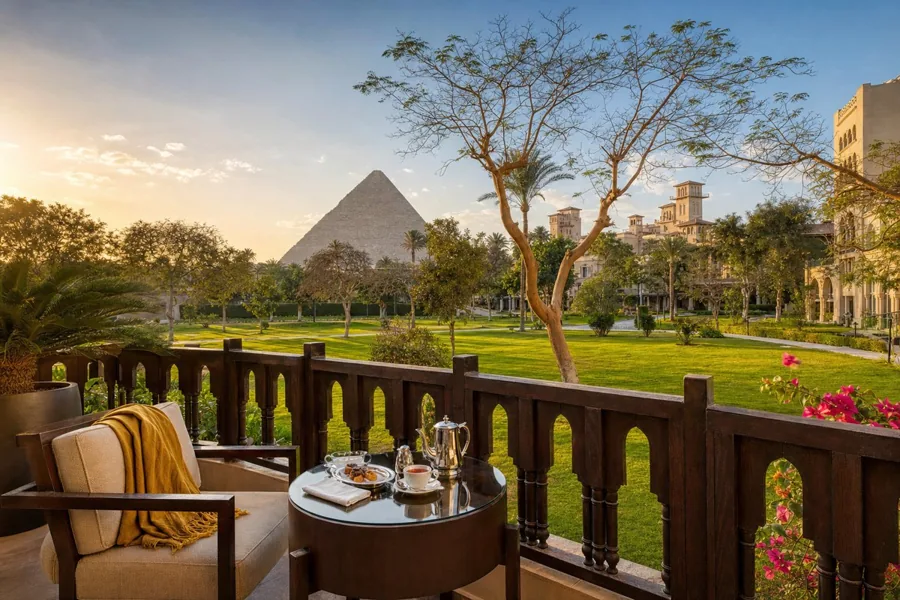
For those who want space, garden, and pool instead of a rooftop terrace
Frequently asked questions
Is my taxi allowed to drive onto the site?
No. Private vehicles and tour buses stay outside. The driver drops you off at the gate and waits there.
How do I get to the individual monuments then?
On foot or with the electric shuttles, which are included in the entrance fee and serve the key points.
Are there exceptions?
Reported are private electric vehicles for an extra fee, own buses for larger groups, and access for limited mobility, each after prior registration. This is not officially documented, so clarify in advance.
Since when does this apply?
Since the reorganization of the visitor operation, which went into trial operation in spring 2025. Older travel guides describe the previous state.
Do I have to expect waiting time?
On busy days, yes. After the change, there were reports of waiting times at the stops. Arriving early mitigates this.
Where do I wait for my driver?
At the previously agreed spot in front of the gate. Set the point and time before you go in, because communication from inside is unreliable.