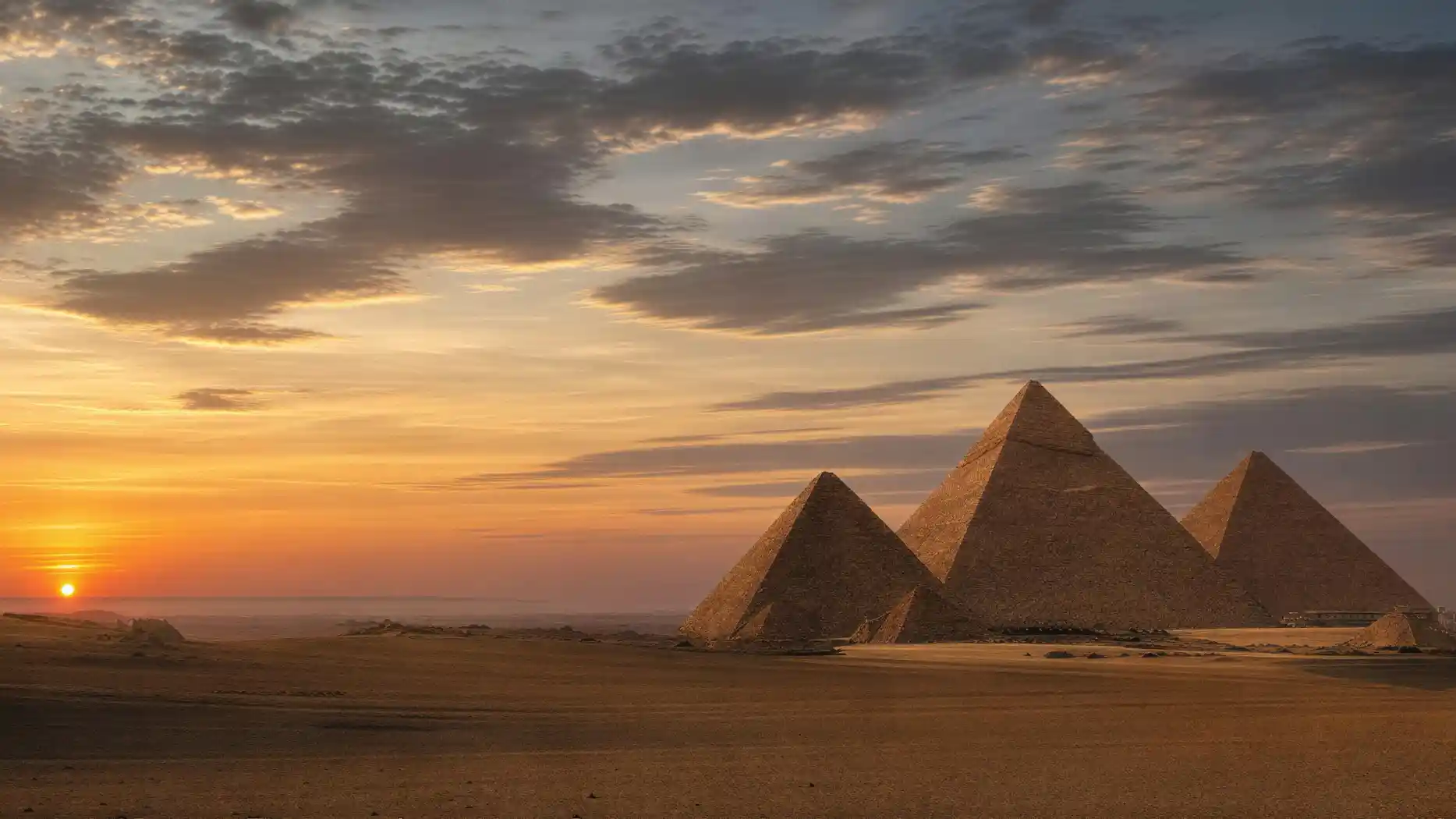
Protection and safety in Giza are rarely perceived as such by visitors. What is perceived are restrictions: a fence, two gates, a baggage check, a driving ban, a tight quota for the interior, changing openings at the tombs, a ban on drones.
This list is also the answer to the question of how the site is protected. Almost every rule that makes the visit more cumbersome is a protective measure, and most of them can be attributed to a specific damage that would occur or has occurred without them.
This is not appeasement but a useful reading aid. Those who know that the quota for the largest pyramid has to do with measured humidity and not with scarcity as a sales trick will be annoyed differently. And those who know what damage this site has suffered in the last two hundred years will not read a fence as harassment.
A look back makes the scale clear. Of the structures, the entire smooth outer casing is missing, removed over centuries and built into the growing city. A museum stood for decades directly on the south flank of the largest pyramid. Until 2025, tour buses drove between the structures. Measured against that, the current state is not restrictive but the result of a development in which protection only became the guiding principle late.
This page organizes the system: first the structural and technical security, then the question of who is actually responsible, then the conservation measures that appear as visitor rules, and finally the point where this protection ends. The climbing question and the condition of the structures have their own pages.
Which rule protects against what
The same points that appear as criticism in reviews, read once from the other side.
| What you notice | What it is directed against | Who is behind it |
|---|---|---|
| Fence and only two gates | Uncontrolled access, stone theft, damage outside opening hours | Antiquities Authority and Ministry of Interior |
| Baggage check at the entrance | Dangerous objects, unauthorized equipment such as drones and tripods | Security forces at the gate |
| Driving ban on the site | Exhaust fumes, vibration, dust swirling, disorderly traffic between structures | Operator of the visitor operation, on behalf of the administration |
| Tight quota for the interior | Moisture from breath and sweat that destroys the plaster | Antiquities Authority |
| Changing opening of individual tombs | Damage to painted walls from moisture | Antiquities Authority |
| Ban on drones | Risk of crashing, uncontrolled overflights; regulated nationwide | Legislator, enforced at customs and gate |
| Licensing requirement for providers | Harassment, price disputes, uncontrolled animal husbandry | Operator and administration since the renovation |
- What it is directed against
- Uncontrolled access, stone theft, damage outside opening hours
- Who is behind it
- Antiquities Authority and Ministry of Interior
- What it is directed against
- Dangerous objects, unauthorized equipment such as drones and tripods
- Who is behind it
- Security forces at the gate
- What it is directed against
- Exhaust fumes, vibration, dust swirling, disorderly traffic between structures
- Who is behind it
- Operator of the visitor operation, on behalf of the administration
- What it is directed against
- Moisture from breath and sweat that destroys the plaster
- Who is behind it
- Antiquities Authority
- What it is directed against
- Damage to painted walls from moisture
- Who is behind it
- Antiquities Authority
- What it is directed against
- Risk of crashing, uncontrolled overflights; regulated nationwide
- Who is behind it
- Legislator, enforced at customs and gate
- What it is directed against
- Harassment, price disputes, uncontrolled animal husbandry
- Who is behind it
- Operator and administration since the renovation
Fence, cameras, and responsibilities
The structural and technical security is the most visible part and the least discussed.
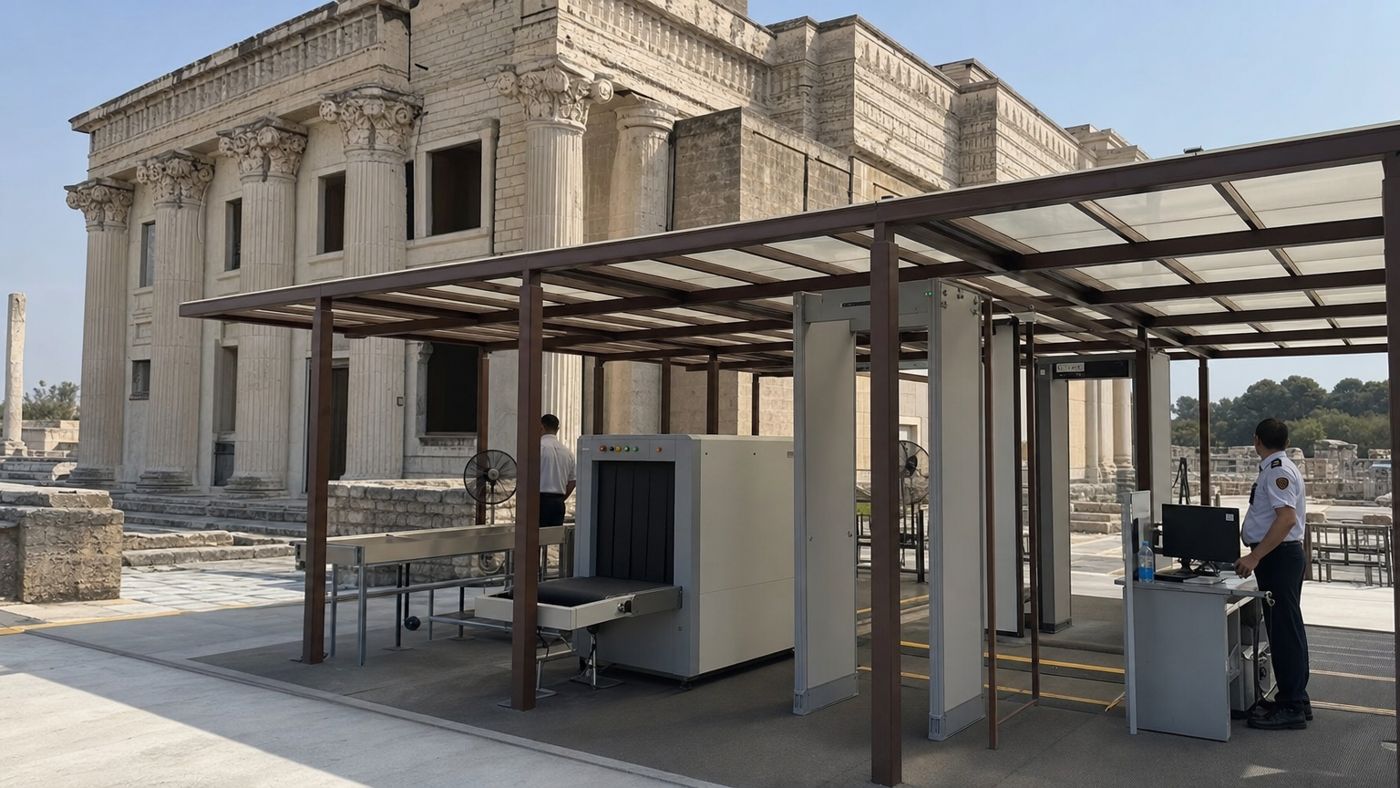
The site is completely fenced, with a fence line on the order of twenty kilometers, and since the renovation it has only two regular entrances. At the main entrance in the southwest, visitors pass a check with an X-ray belt and metal detector, like at an airport. The second entrance is in the east near the Sphinx.
In addition, there is a level that hardly anyone notices. A Spanish provider of surveillance technology describes in a case study of its own from October 2025 a system with more than two hundred and thirty cameras on the site: fixed cameras at the vehicle entrances, on access roads, at the helipad, and along the visitor paths, plus pan-tilt cameras with zoom and infrared for the night at sensitive points. How many cameras are installed is not published. This information comes from the supplier and not from the administration, which should be read accordingly; the order of magnitude, however, matches what is visible at gates and paths.
One point deserves classification because it regularly appears in reviews as an intrusion. The check at the gate is not primarily directed against visitors but against objects: drones, tripods, tools, in rare cases dangerous things. For a site that admits millions of people annually and whose substance is irreplaceable, an entrance check is the mildest available measure. The alternative would not be freedom but a restriction of access.
For responsibility, there is a three-way division that one should know because it explains whom to address for what. The Antiquities Authority is responsible for the site as an excavation site and everything concerning the substance. The Ministry of Interior provides the security forces together with it, including the tourist police. The private operator of the visitor operation is responsible for the entrance, vehicles, cleaning, and the guarding of the visitor areas. If you have a problem with a provider, you contact the operator; if you see damage to a structure, you contact the administration.
Privately guided half-day with time for explanations
- Most rules at the site are not signposted; a local guide explains what applies where
- Pickup from accommodation and entry to the site are included
- About four hours, German-speaking guide possible
- According to the provider, free cancellation up to 24 hours before
Rules that look like whims and are protection
The more interesting part is the invisible one, and it consists of rules that look like administrative whims and are conservation measures.
The clearest example is the quota for the interior of the largest pyramid. It goes back to a specific incident: in 1998, the structure was closed because the humidity inside had risen to eighty percent due to visitors. Every person releases about twenty grams of water through breath and sweat, and this moisture transports salts into the plaster. The number of tickets is therefore not a sales instrument but an upper limit for water vapor.
The changing opening of individual tombs works on the same pattern. Painted walls react more sensitively than bare stone, which is why chambers are temporarily closed. That there is no published list is annoying for visitors and irrelevant for the walls.
The driving ban also belongs here. It was perceived as an administrative measure but works mainly against exhaust fumes, vibration, and swirling dust on structures whose surfaces are already weathering. And the reorganization of visitor operations since 2025 has moved providers to designated areas, which reduces sales pressure and at the same time the burden on the structures.
The rules on photography also belong in this series, though only partially. Private photos are explicitly permitted and cost nothing; equipment that blocks paths or introduces additional light requires a permit. The purpose is twofold: it protects the substance from structures and lighting and at the same time the operation from blockages at places where everyone stands anyway.
And the most famous case of this kind is the ban on climbing the structures. It has its own legal basis, it is enforced, and it protects two things at once: the edges of the stone layers, which crumble under footsteps, and the people who regularly underestimate how high fifty meters feel on the way down. The details are on a separate page.
One measure remains that is not a rule but technology: since September 2025, an air purification system has been working inside the largest pyramid, installed in the chambers, with the stated goal of reducing humidity. It does not change the quota, but it shows that the same cause is being worked on from two sides.
The protection ends at the fence
The unpleasant half remains: this protection ends at the fence, and the greatest dangers to the site come from outside.
The plateau lies on the edge of a metropolitan area with a double-digit million population. Residential buildings stand directly at the fence, and what happens there is beyond the control of the Antiquities Authority. Construction projects, traffic, sewage, and groundwater have an effect across the boundary, without a ticket system or a camera changing anything about it.
The entire necropolis has been on the UNESCO World Heritage List since 1979, and this status is the most effective instrument against such projects, but it is not a prohibition. It obliges the state to report and enables international pressure, but it cannot stop a construction project. What that looks like in practice can be read in the dispute over a planned ring road, which is treated on the World Heritage page.
A second gap concerns the neighboring fields. While official pages with times and tariffs exist for the plateau itself, an adjacent excavation field is not listed at all in the administration's list. What is not in a list is also not protected in a list.
A third gap is temporal in nature and concerns the night. The site closes in the late afternoon, and what happens there afterward completely escapes the observation of visitors. That is exactly what the infrared cameras are for, and that is exactly why the number of cameras is a relevant piece of information and not just technical prose. A fence without observation is a line in the sand.
A fourth gap is personnel-related and rarely mentioned. A site of this size with millions of visitors a year cannot be supervised without gaps. Staff are present at the known points, but not continuously in the tomb fields and at the edges. Whoever respects a barrier there does so of their own accord, and that is exactly what the system relies on at many points. This is not a criticism of the administration but a characteristic of open monuments.
And a fifth concerns information. The official overview of the site lists opening hours and prices, but neither the condition of individual areas nor the ongoing measures nor the question of accessibility. A protection system that is not reported on can neither be checked nor appreciated from outside, and this circumstance has come up at several points in the course of this chapter.
What visitors can actually contribute
- Buy the ticket through the official channel or an established provider, not on the street
- Do not touch anything with paint, plaster, or relief remains
- Do not bring a drone; the ban applies nationwide and begins at customs
- Do not buy anything as antique, because there is an export ban on antique objects
- Address the responsible authority in case of damage or harassment instead of posting the video
- Follow paths and barriers, even where there is no staff
Frequently asked questions
Who is responsible for the protection of the site?
The Antiquities Authority for the substance, the Ministry of Interior for security, the private operator for visitor operations.
Is the site monitored?
Yes. According to a technology provider, more than two hundred and thirty cameras are in use, at entrances, paths, and sensitive points.
Why is the interior quota so small?
Because of humidity. In 1998, the largest pyramid was closed for this reason; the limit comes from that experience.
Why are some tombs closed?
Because painted walls react sensitively to moisture. The opening changes and is not published.
Does the World Heritage status protect against construction projects?
Not directly. It obliges to report and enables pressure, but it cannot prohibit anything.
What happens if you break the rules?
Depending on the case, expulsion, confiscation, or prosecution. For climbing, there is a separate legal regulation.