The Sphinx viewing terrace is where the most common disappointment of the whole plateau occurs, and for a reason that is easy to avoid: almost all the famous pictures give the impression that you are standing right in front of it.
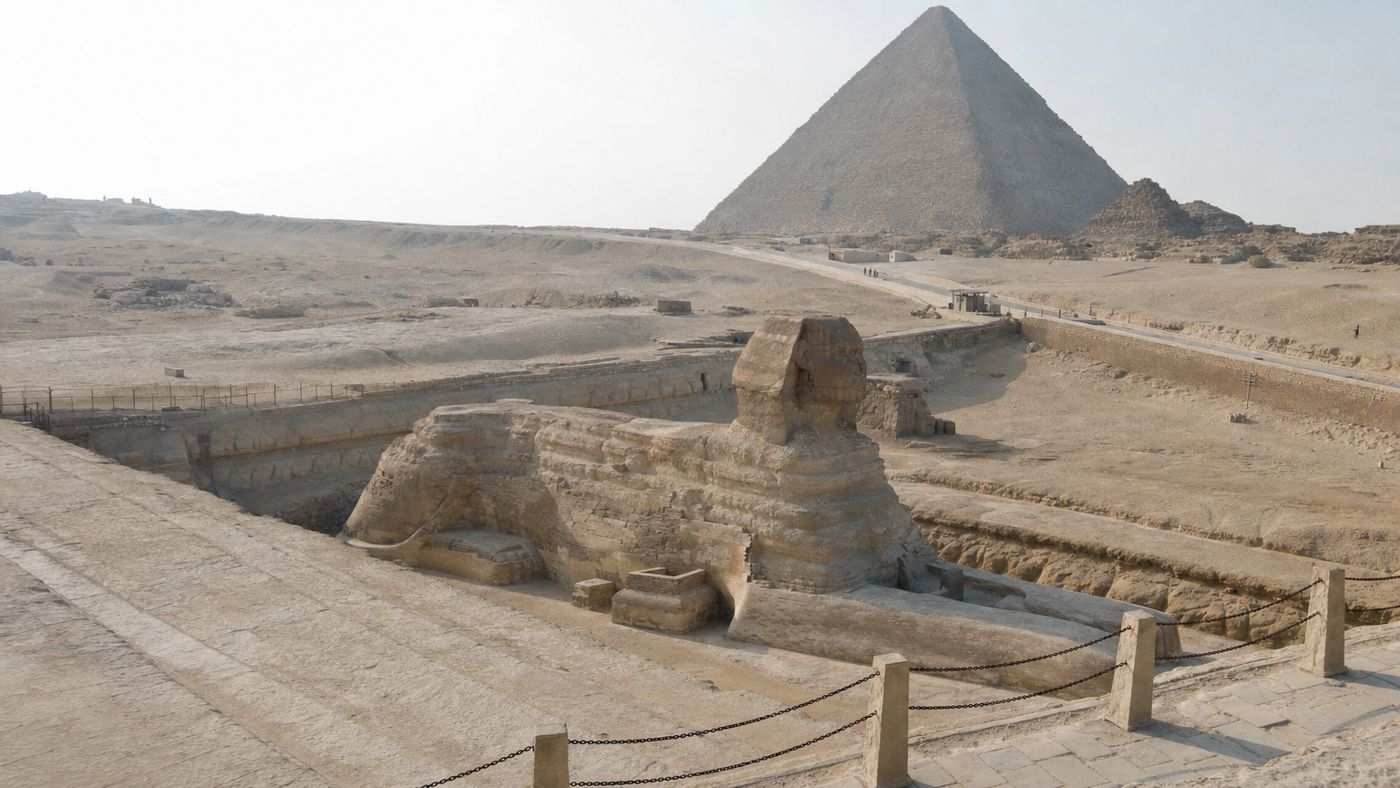
You are not standing right in front of it. The Sphinx is fenced off, the area between the paws is not accessible, and you view the figure from a distance of several dozen meters, from an elevated area on the east side. This is not a barrier against you personally, but the normal state for decades.
The more interesting part is the second: you do not look up at it, but down on it. The Sphinx lies in a pit that was created when the figure itself was carved out, and the terrace lies at the top edge of this pit. This view from an angle from above is unusual, but it explains why the figure often appears smaller in photos than expected.
The fact that the pit is fenced off at all has a conservation reason, not an organizational one. The figure is made of the natural limestone, which is soft in the lower layers and has been weathering for millennia; the repairs on the flanks are visible even from a distance as lighter areas. Public traffic right at the foot of the figure would be the last thing it needs. Knowing this, you read the fence differently.
This page therefore does not describe the Sphinx itself – that has its own page – but the locations: from where you can see it, which location produces which image, when the light is right, and what is explicitly not possible.
The locations and what they offer
The terrace on the east side
The elevated area opposite the head, right next to the eastern gate. The spot where practically everyone stands.
- Good for
- The view from the front onto the face, and in the late morning for pictures without backlight.
- Watch out
- This is where it is most crowded, and the distance to the figure is greatest.
The path on the north side of the pit
The route you take coming down from the pyramids, running along the top edge of the pit.
- Good for
- The side view with the full length of the body and for the sightline with a pyramid behind.
- Watch out
- Not a designated viewpoint, but a path. Stay on it.
The area near the temples
In front of the paws lie the Sphinx Temple and next to it the Valley Temple, both at the level of the pit.
- Good for
- The view from below at an angle upwards, which best conveys the size.
- Watch out
- How far you can get there today depends on the route, which changes with the renovation.
The sightline with the pyramid behind
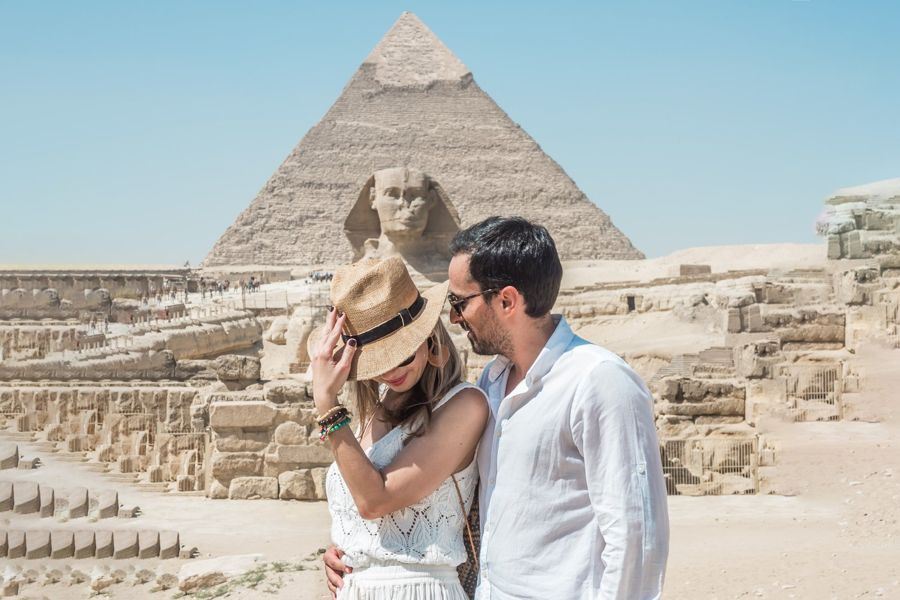
The sightline that almost everyone looks for is the one with a pyramid behind the Sphinx, and it only works from certain points.
The reason is geography. The Sphinx lies at the eastern, lower end of the complex, while the pyramids stand to the west and higher. So if you position yourself so that you look at the figure from the east or southeast, you get the pyramid in the same line. If you photograph from the front, you get only sky behind the head.
That is why the classic shot is not a frontal view, but an angled one. In the famous pictures, the photographer stands south or north of the axis, and the pyramid appears over the shoulder of the figure. This is also why these shots distort the size difference so much: a structure at some distance appears smaller next to a nearby figure than it is.
This also clears up a disappointment: the shot where someone seems to kiss the Sphinx or touch its nose is not taken on the terrace or in the pit. It is taken from a considerable distance with a long focal length and a second person standing far in front. Knowing this, you plan it for what it is: a trick that requires distance, not proximity.
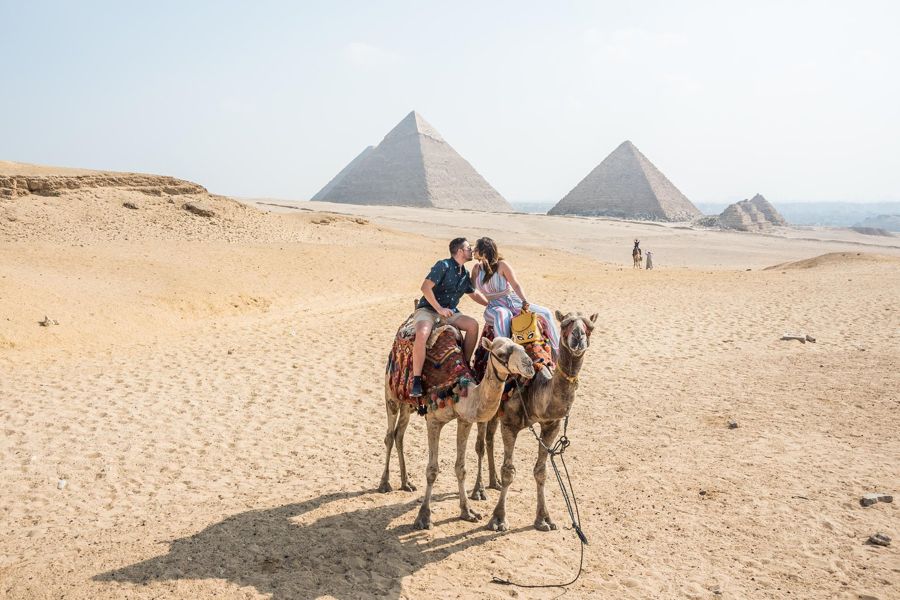
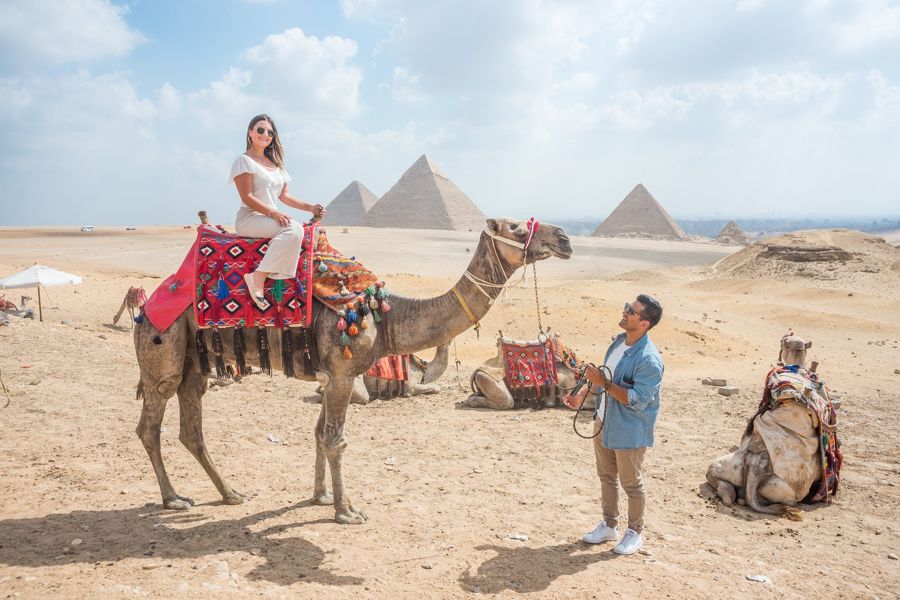
Privately driven half-day tour with your own schedule
- The time spent at the terrace is up to you, not a group, which is crucial for the morning light
- Pickup from your accommodation and entry to the site are included
- Around four hours, German-speaking guide possible
- Free cancellation up to 24 hours before, according to the provider
The light determines the whole day
When it comes to light, there is a rule that results from the construction and determines the whole day.
The Sphinx faces east. In the morning, the sun is behind you when you look at the face from the terrace, illuminating it from the front. In the afternoon, it moves behind the figure, the face lies in shadow, and you photograph against the light. For photos, the morning is therefore not just more pleasant, but simply the only time when the face is lit.
This creates a conflict with the usual route around the site. If you start at the main entrance in the southwest and do the loop, you reach the Sphinx last, i.e., in the early afternoon. That is exactly when the light is wrong.
You can resolve this with a stop: on the first round, get off at the Sphinx, go to the terrace, take your shots, and get back on without using the eastern gate. Then continue the loop. This costs twenty minutes and resolves the contradiction between order and light.
A second point about crowds belongs here, because it further favors the morning. The terrace is a limited area where everyone who wants the picture gathers, making it one of the few places on the site where there is actual crowding. The tour buses arrive more orderly than before after the reorganization of visitor operations, but they still arrive between nine and ten o'clock. If you are there before that, you almost have the area to yourself.
Conversely, if you start at the eastern gate, you do not have this problem, you see the figure first and in the best light, but you must already have your ticket because they do not sell them there.
Can you get closer?
The question remains whether there is a way to get closer, and the answer is more nuanced than a simple no.
For the normal visit, the answer is no. The pit is fenced off, the area between the paws is not accessible, and neither a ticket nor a tour changes that.
As for the route, more can be said now, and first a common assumption needs correcting: the pit itself has not been renovated. What has been renovated is the access path. The public path comes from the east, through the Valley Temple of Khafre and up the causeway ramp to the terrace. You stand there above and in front of the paws and look down and west. There is no walkable circular path on the north side of the pit for the public, and that is the answer to the most frequently asked follow-up question.
The Valley Temple is the opportunity most people overlook. It can be entered with the general ticket and is thus the closest accessible interior space to the Sphinx at all. The Sphinx Temple directly in front is passed, not entered. The exact course of the barriers changes with the ongoing work on the access path; in spring 2025 a gate opposite the Sphinx was closed, and in February 2026 the main path was under construction. The terrace is fixed, the path to it is variable.
However, there is an official category for closer access, and you should know it to classify offers. According to a circular from the travel industry, based on a board decision of the Supreme Council of Antiquities, there is a regulated fee for private access outside opening hours, for the Sphinx for a duration of one hour. It is a group fee, supervision costs are added, and without a written permit with date and monument, such an offer is worthless.
This is confirmed in a place you would not look. The ministry's price list has a separate line for the Sphinx, and this line is the only one in the whole Giza table that does not have a normal tariff, but the addition that it concerns exclusively private visits, plus an opening fee. Closer access is therefore neither an invention of organizers nor a gray area, but a designated category with its own entry in the official list.
Two things follow from this. First: anyone who offers you on the site to get you closer for cash is selling something they are not allowed to sell. Second: serious offers of this kind exist, but they go through organizers, cost significantly more than an entry ticket, and are a group service.
For everyone else: the terrace is the place, and it is better than its reputation. The distance does not take away from the figure's impact once you stop trying to recreate the picture from the travel brochure.
- Standing between the paws
- not possible
- Usual distance
- several dozen meters, from the elevated terrace
- View direction
- from an angle from above, because the figure lies in a pit
- Light on the face
- in the morning, because the Sphinx faces east
- Pyramid in the background
- only from an angled axis, not frontal
- Included in the site entry
- yes, there is no extra ticket
Private car with a knowledgeable driver in Cairo and Giza
The terrace is right at the eastern gate, and that is the shortest way to the figure. However, it does not sell tickets, so you need the card in advance. A driver who knows this drops you off at the right end instead of at the visitor center in the southwest. Free cancellation.
Frequently asked questions
Can you stand between the paws of the Sphinx?
No. The pit is fenced off, and neither a ticket nor a tour changes that.
How close can you get?
To a few dozen meters, from the elevated terrace on the east side.
Why do you look down on it?
Because the figure lies in a pit that was created when it was carved out. The terrace lies at its edge.
When is the light best?
In the morning. The Sphinx faces east; in the afternoon, the face lies in shadow.
How do I get a pyramid behind the Sphinx?
Only from an angled axis from the north or south. Frontal, there is only sky behind the head.
Is there a way to get closer?
Only via an officially regulated special permit outside opening hours, as a group service through an organizer.