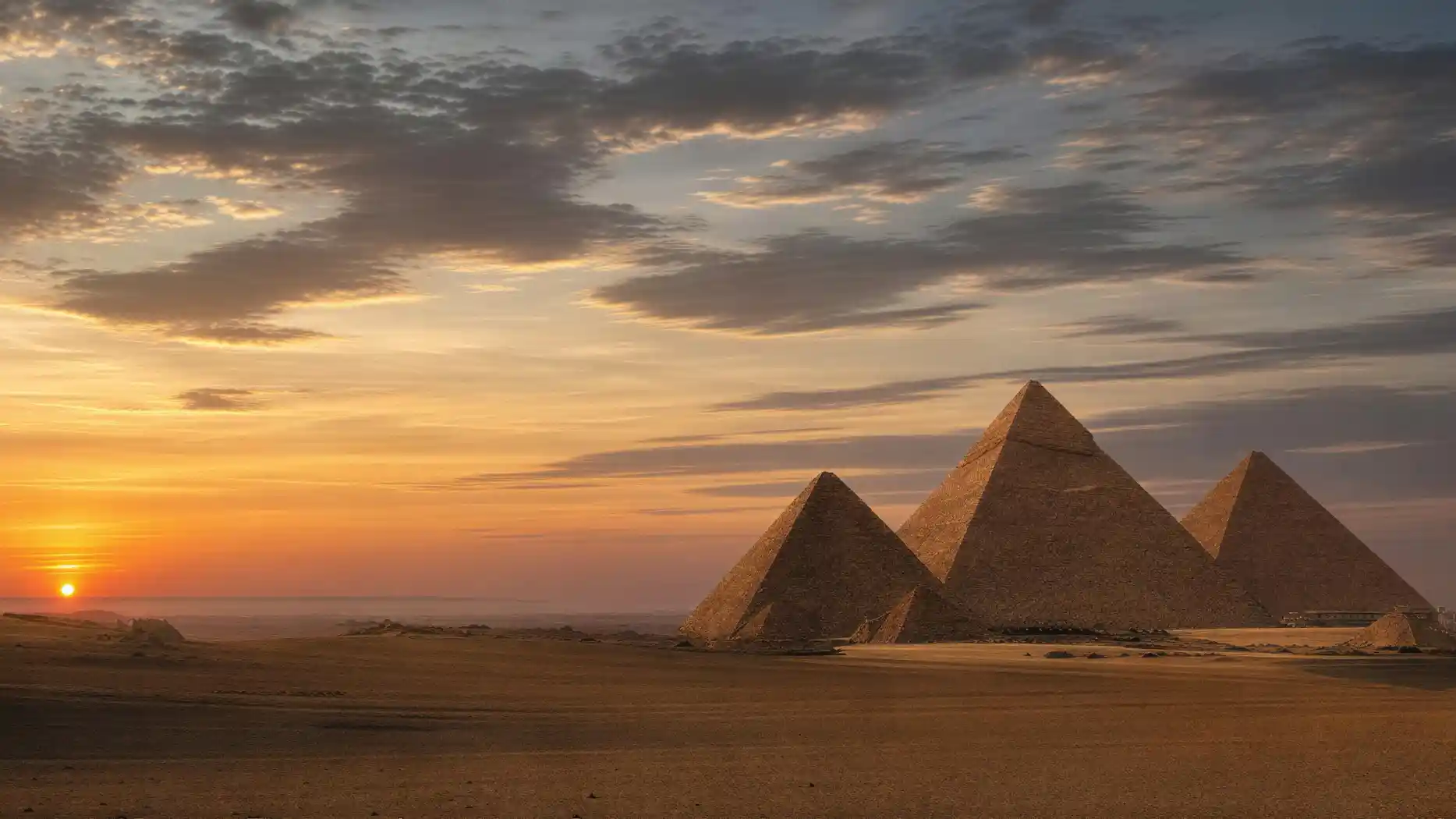
There is exactly one spot on the entire site where the three great pyramids line up neatly in a single frame, and nearly every photo you know from this place was taken there.
The reason is geometry. The three structures are not arranged in a simple row; they are staggered diagonally along a line running from northeast to southwest. If you stand to the side of that line, you see them one behind the other, obscured. If you stand at one end and look back, you see all three at once, receding into the distance.
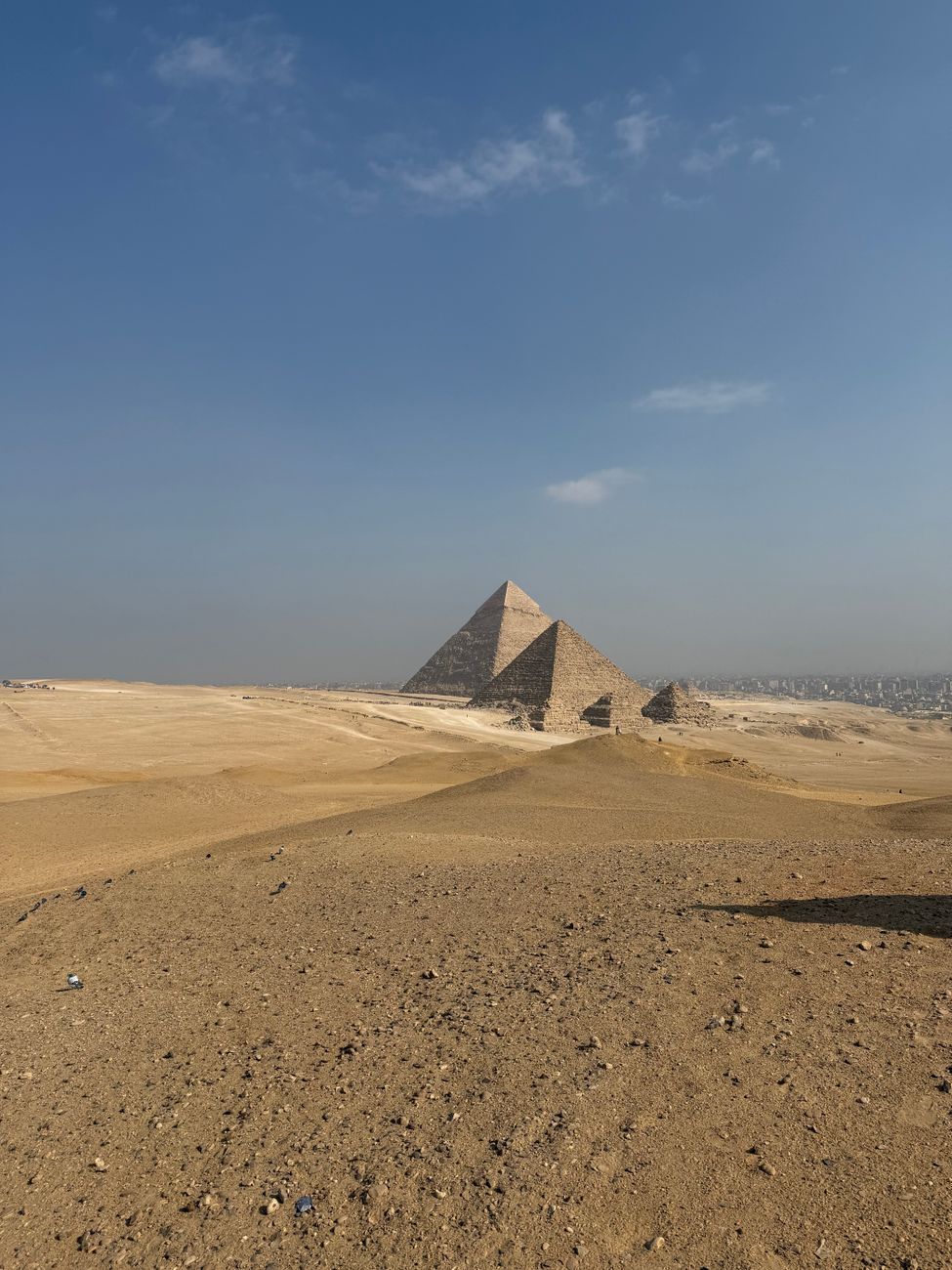
That end lies to the southwest, outside the structures themselves, on open desert ground. From there, you look over the smallest pyramid at the middle one, and beyond it at the largest. The spot has no ancient significance, no ruins, and nothing to see. It is purely a vantage point.
It is also the shuttle's first stop from the main entrance, so for most visitors it is the first glimpse of the site. This order is new. Until 2025, you approached from the northeast, from the wrong side for this view.
What surprises many people: from there, you see not three pyramids but considerably more.
In addition to the three great pyramids, there are smaller satellite pyramids belonging to the same complexes. South of the Menkaure pyramid, three queen's pyramids stand in a row, and the other two complexes also have such satellite buildings. On a clear day, from the right spot, you can count up to nine pyramids at the panoramic point.
They are easy to miss, and there's a simple reason: size ratios. The smaller buildings reach only about thirty meters, standing next to structures over one hundred thirty meters tall. In a photo, they nearly disappear, even though each one is a large tomb in its own right.
If you know what to look for, you'll see the site differently from there: not as three individual structures, but as what it is: a planned necropolis with main buildings, satellite buildings, and burial fields in between.
A note for photos: the well-known motif is captured with a slight telephoto lens, which visually compresses the buildings. In fact, there is a good kilometer of open sand between the first and the third.
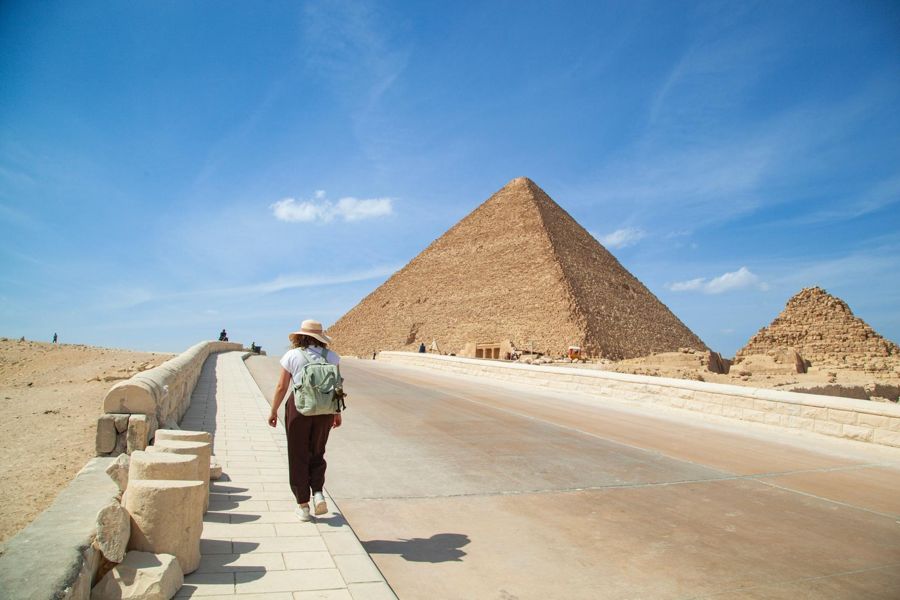
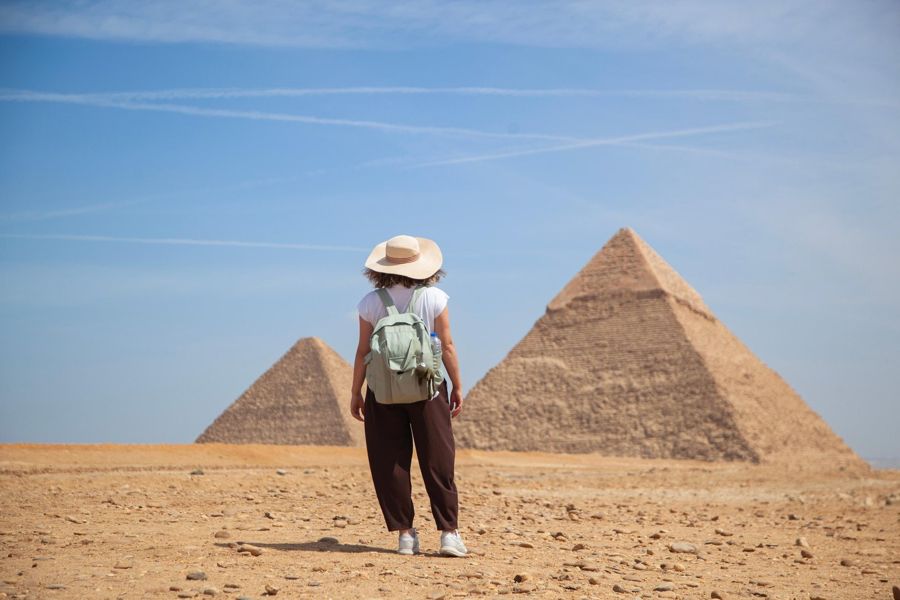
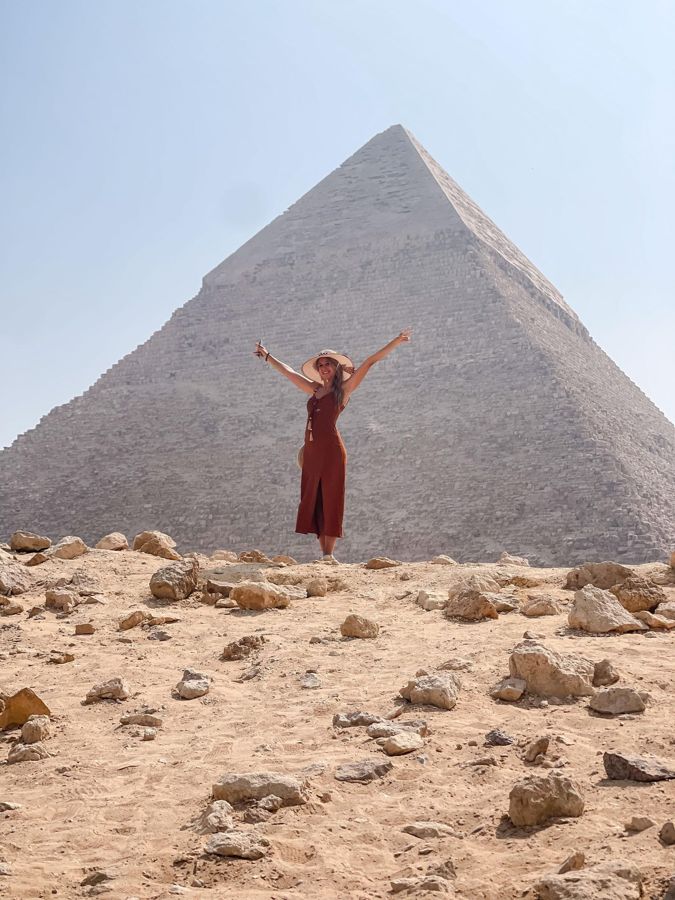
Short guided tour of the plateau on foot
- A guide visits the viewpoints in the order in which the light is best
- Three hours, without the museum part, just right for the morning
- Plateau entry and priority admission included
- Free cancellation up to 24 hours in advance
What you can see from the panoramic point
From left to right, in the order they appear as you look northeast.
| Structure | Distance | Prominence in the image |
|---|---|---|
| Pyramid of Menkaure | closest | despite proximity appears smallest, originally 65 m |
| Queens' pyramids of Menkaure | right next to it | three small cones, easy to overlook |
| Pyramid of Khafre | middle distance | appears largest, stands on higher rock, remains of casing at the top |
| Great Pyramid of Khufu | farthest | in reality the largest, appears smaller due to distance |
| Other satellite pyramids | scattered | countable depending on view and position |
| Outskirts of Giza | beyond | invisible in haze, clear in crisp air |
- Distance
- closest
- Prominence in the image
- despite proximity appears smallest, originally 65 m
- Distance
- right next to it
- Prominence in the image
- three small cones, easy to overlook
- Distance
- middle distance
- Prominence in the image
- appears largest, stands on higher rock, remains of casing at the top
- Distance
- farthest
- Prominence in the image
- in reality the largest, appears smaller due to distance
- Distance
- scattered
- Prominence in the image
- countable depending on view and position
- Distance
- beyond
- Prominence in the image
- invisible in haze, clear in crisp air
The Pyramid of Khafre appears larger from here than the Great Pyramid of Khufu. That is an optical illusion due to the height of the ground, a steeper angle, and shorter distance.
Two ways up
Getting there has become easier since the site was reorganized, and there are two ways.
The comfortable one is the shuttle. From the main entrance in the southwest, the electric ring bus departs, included in the entry price, and the panoramic point is the first stop. Buses run at short intervals, so waiting times are manageable. With the shuttle, you'll be there in a few minutes.
The other way is on foot, taking about half an hour from the main entrance across open, shadowless terrain. In winter, it's a pleasant walk with constantly changing views. In summer, it's a bad idea, especially around midday.
Private vehicles are no longer allowed on the plateau, which particularly affects this spot, because tour buses used to stop right here, and the area was correspondingly cluttered. If you compare old photos of the panoramic point with today's, you'll see the difference immediately.
You need your ticket beforehand. Buy it online through the official portal of the Ministry of Antiquities or at the main entrance; there is no ticket office at the eastern Sphinx gate.
Two quiet windows, not one
Regarding timing, this place has a peculiarity that sets it apart from other spots on the site: there are two quiet windows, not just one.
The first is well known. The site opens around eight o'clock, and the first hour is largely yours alone. The tour buses only start arriving around nine thirty and then bring group after group for hours.
The second window is much less known. In the early afternoon, most groups leave because their half-day tours end, and from around three o'clock it becomes noticeably emptier. At the same time, the sun is lower, the light warmer, and shadows longer. For photos, that's the second-best time of day, and there's less competition for good spots than in the morning.
The season shifts both considerably. Between October and February, temperatures are pleasant, air is clearer, and the sun sets early, so the afternoon window falls before closing. In summer, the afternoon at the panoramic point is mainly hot, as there is no shade there at all.
If you have only one chance and have to choose: The morning is more reliable because haze over the city area increases as the day progresses.
This is where the camels are now
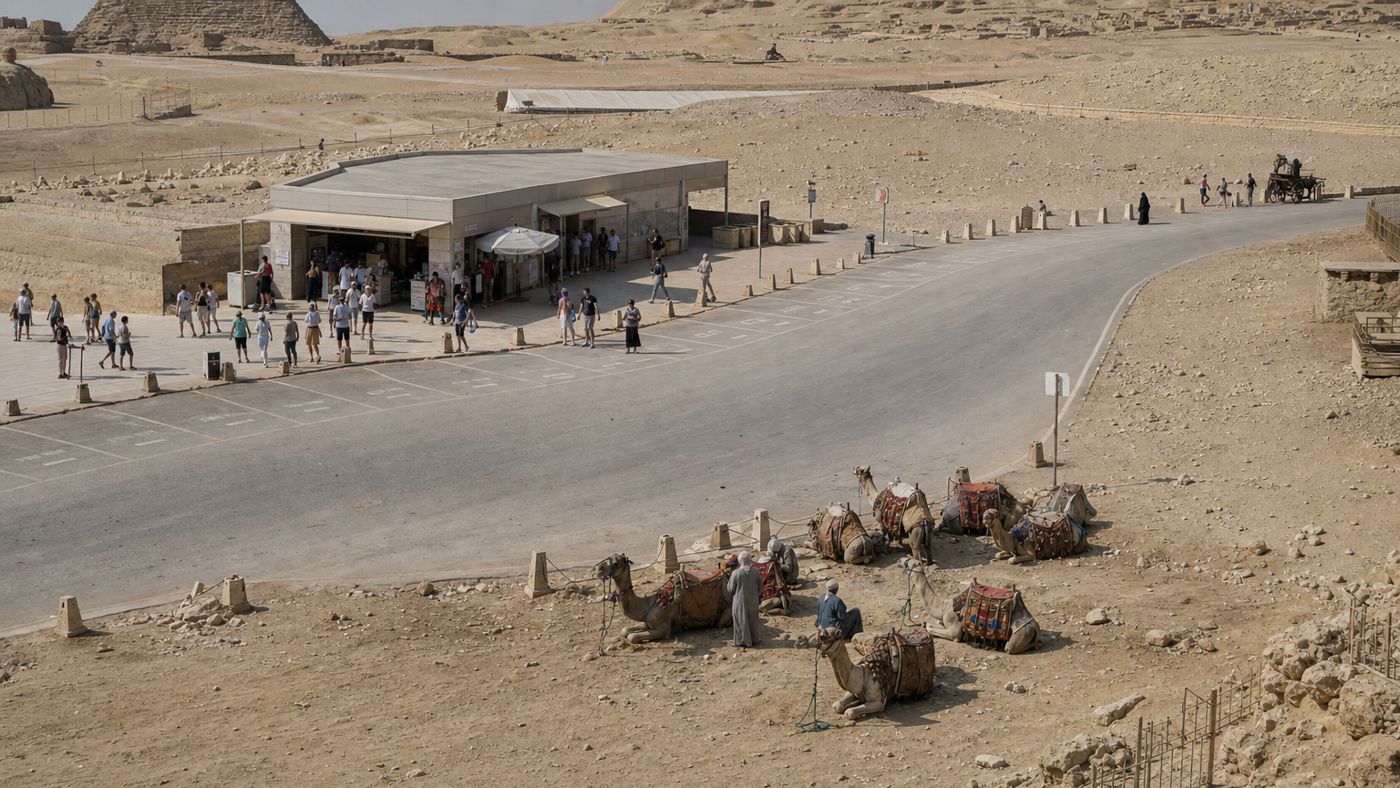
With the reorganization of the site, camel and carriage ride providers have been relocated to designated areas, and one of them lies right at the panoramic point next to the café. That is an improvement over the past, when they approached visitors all over the site. But it also means: at this one spot, the density of offers is high. If you don't want a ride, say no once, politely and firmly, and move on. If you want one, clarify the amount, currency, duration, and number of people in advance, or book it as part of a service that's already paid for.
What's there now
Unlike in the past, there is now some infrastructure at this point, which changes how long you stay.
There is a café and restrooms, though using the toilets, as everywhere on the site, costs a small fee, and cash is handy for that. Both sound trivial, but they are why many visitors stay longer than planned: it's the only place in the western part of the site where you can sit down and get a drink.
There is practically no shade, apart from what the café itself offers. The ground is sand and gravel, and when it's windy, dust hangs in the air. If you have sensitive camera gear, change lenses elsewhere.
The remodeling of the site is part of a larger program that has been running since 2025 and was extensively covered by the Egyptian press. For visitors, this mainly means: what older travel reports say about chaos at this point describes a condition that no longer exists.
Plan for twenty to thirty minutes of your time if you're photographing, and considerably more if you take in the café.

Private tour of the plateau with camel ride and lunch
- The ride starts in the area where providers are anyway, but at a fixed price
- No second point of negotiation, since the service is paid for in advance
- Four hours with your own guide, pickup and lunch included
- Free cancellation up to 24 hours in advance
Plateau entry as a QR code on your phone
The shuttle to the panoramic point is included in the entry price. So one ticket is enough to get to this spot.
Frequently asked questions
Does the panoramic point cost extra?
No. It's part of the open area, and the shuttle ride there is included in the basic admission.
Why does the middle pyramid appear larger from there?
Because it stands on rock about ten meters higher, rises more steeply, and is closer to the camera. In reality, it is smaller than the Great Pyramid of Khufu.
When is it emptiest there?
In the first hour after opening and again from about three o'clock, once the half-day groups have left.
Can you see the sunset there?
More likely in winter than in summer, because the site closes early in the evening and the sun sets significantly earlier in winter. Don't rely on it; ask about the closing time at the entrance.
There's a small irony about this place that strikes you once you've been there.
The panoramic point is the most photographed spot in a site that is otherwise about closeness. Everywhere else on the plateau, you stand against a wall of stone, touch blocks, walk through passages. Here, you deliberately step back, several hundred meters, until the structures are small enough to fit together.
That is exactly its value. From here, you understand the layout, the size relationships, and the fact that this is a planned group, not three separate projects. That is a different piece of information from what the foot of the Great Pyramid offers, and together they give a complete picture.
Practically, that means: do both, and in that order. First, get the overview from the panoramic point, then go down to the structures themselves. If you do it the other way around, you'll reach the viewpoint when the sun is already high and the groups are there.
That the entire necropolis has been on the UNESCO World Heritage List since 1979 is most evident at this viewpoint. What you see from there is not a single structure but a landscape, protected as a whole.