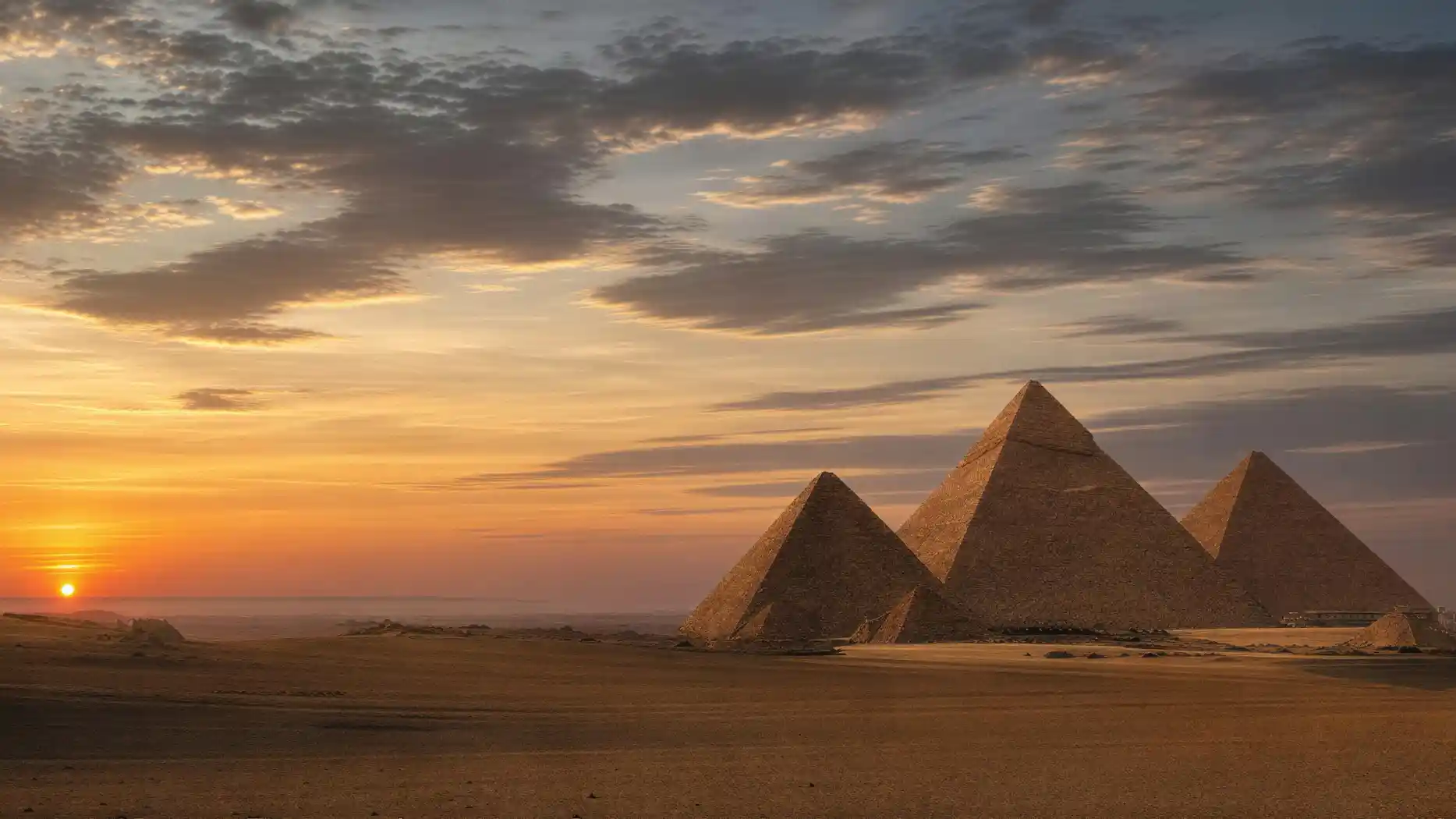
Claustrophobia inside the pyramids is the question most often asked too late. Usually, it only comes up after the extra ticket has been bought, and that ticket is expensive, scarce, and non-refundable if someone turns back at the entrance.
The honest answer is: it depends, and not on the narrowness, but on something else.
First, the good news. The interior is not a cave system. It's lit, the path is clear, it's short, and it's open at both ends. If you get uneasy in an elevator or in an MRI tube, you'll find different conditions here, because nothing closes behind you.
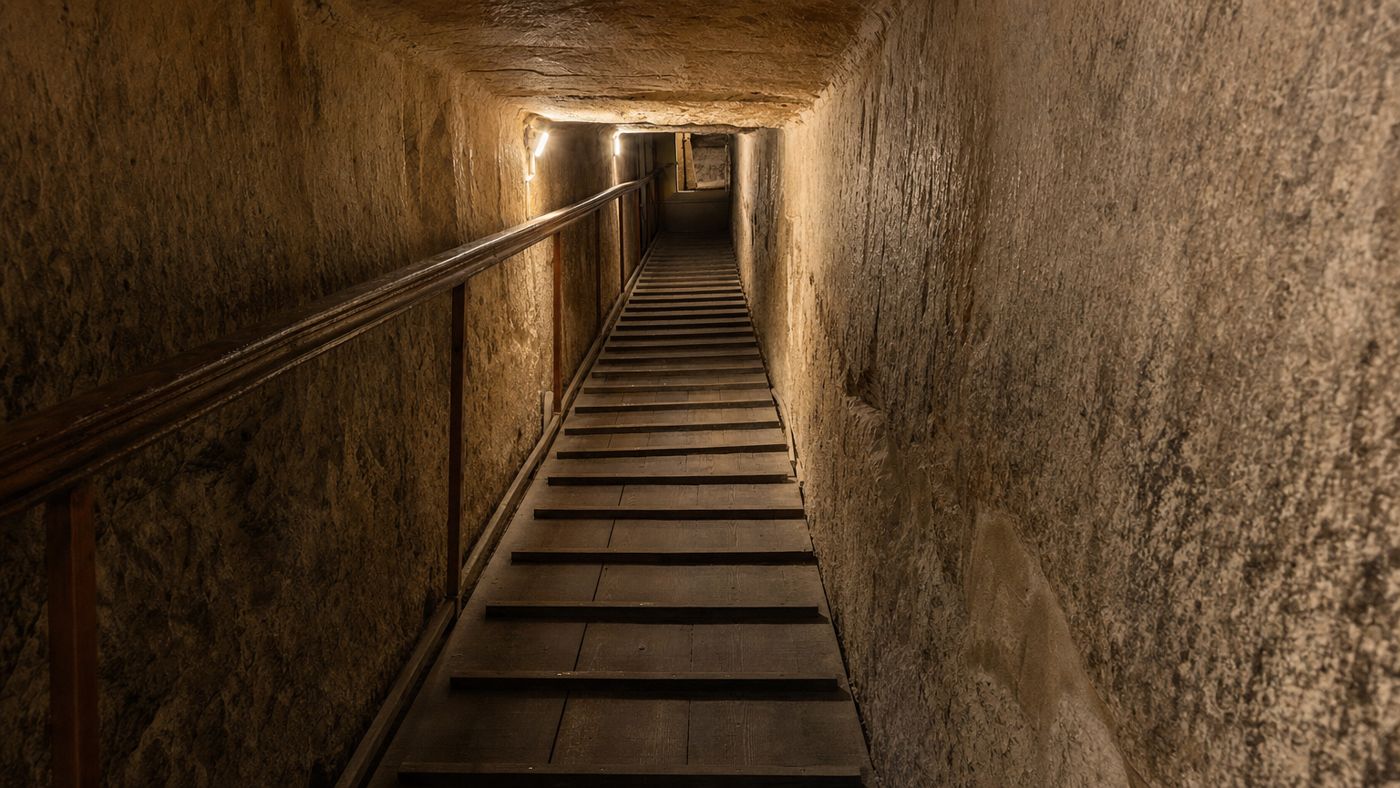
And now the point where many descriptions stop, even though it's the most important one. On the critical stretch, you can't simply turn back. The passage is so narrow and so low that oncoming traffic has to squeeze past each other sideways. If you want to go back halfway, you have to go against the flow, bent over, on slanted planks. It's precisely this lack of a quick exit that turns discomfort into panic, not the number of cubic meters.
The three interiors ranked by stress, not by sightseeing value
Great Pyramid of Khufu
The long, bent-over climb of about 39 meters at roughly 1.20 meters in height, followed by the tall Grand Gallery and the burial chamber.
- Good for
- Those who can physically manage the climb and want to see the Gallery, which has no counterpart elsewhere.
- Watch out
- The most strenuous and warmest route of the three, plus the biggest crowds and the most expensive access.
Pyramid of Khafre
A descending passage, shorter than the climb in the largest pyramid, then a plain rock chamber with a sarcophagus.
- Good for
- Those who are unsure and want to first find out how they react.
- Watch out
- Here too, you walk bent over. The chamber is austere, with no grand images.
Pyramid of Menkaure
The smallest of the three, a descending passage, then an antechamber and burial chamber with a barrel-vaulted ceiling.
- Good for
- Those who want the shortest route but still want to see a complete interior.
- Watch out
- Not always open. Whether it's accessible is decided on the day itself.
What the climb actually demands
What the climb in the largest pyramid actually demands can be put into numbers, and the numbers help more than any description of the atmosphere.
The Ascending Passage is about 39 meters long, roughly 1.20 meters high, and just over a meter wide, with a slope of about 26 degrees. You walk it entirely bent over, on wooden planks with crossbars. For an average fit person, it takes three to five minutes. That's shorter than it feels, and longer than it reads.
Three things come together, and each one alone would be harmless. The posture: your back is bent, your head is lowered, your gaze is on the planks in front of your feet. The heat: it's noticeably warmer and stuffier than outside in the shade, because many people are breathing in a barely ventilated stone room. And the people: someone is in front of you and behind you, often close, and more are coming in the opposite direction.
From this bundle arises the feeling that many describe afterward. It's not the fear of the space, but the realization that you're in a queue whose pace you don't control. This fits well with the technical side: typical signs of claustrophobia include tightness in the chest, shortness of breath, palpitations, and thoughts of escape, and experts estimate that about four percent of the population are affected at some point in their lives. Those affected also perceive a space as smaller and more threatening than it is.
The point that doubles the calculation
One point is missing from almost all descriptions, and it doubles the calculation: you go back down the same passage. There is no second exit and no loop. So what you experience on the way up, you experience a second time, this time downward, with more tired legs and on the same slanted planks. If you just barely manage the climb, you shouldn't assume at the top that the hard part is behind you.
Conversely, there's a group for whom the whole thing is significantly less daunting, and that surprises many parents: children. With a passage height of about 1.20 meters, a child walks upright where adults have to bend, and a large part of the physical strain is thus eliminated. Whether a child likes the narrowness and the crowds is another question and depends on the child. In any case, the posture is the least of the little ones' problems.
Important is the difference between this diagnosis and simple discomfort. The vast majority of those who describe themselves as somewhat claustrophobic get through here. If, on the other hand, you had to stop in an MRI scanner, you should read this page as a warning, not as encouragement.
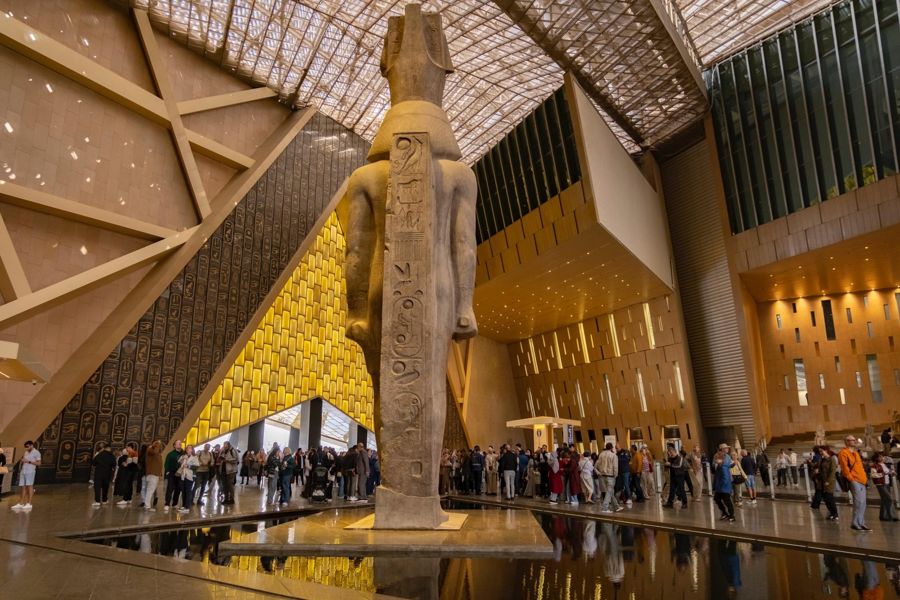
Guided day tour with the plateau, Sphinx, and museum, interior as an add-on
- The interior is planned as an add-on here, so the decision isn't made when booking the day
- German-speaking guide, which matters if you want to ask something or cancel along the way
- Entry to the plateau is included, so the day works even without the interior visit
- Free cancellation up to 24 hours before, according to the provider
The air and its history
That leaves the air, and there's a story about it that thoroughly corrects the impression of neglect.
On April 1, 1998, the largest pyramid was closed. The reason wasn't the structure in the usual sense, but the visitors themselves: the humidity inside had risen to eighty percent. Zahi Hawass, then responsible for the site, noted a calculation that sticks with you. Each visitor releases on average about twenty grams of water through breath and sweat. This moisture condenses on the walls, carries salts into the plaster, and destroys it.
This explains two things at once. First, the stuffiness: it's not a failure, but the direct consequence of people breathing in a closed stone room. Second, the scarce quota that still limits access today and amounts to only a few hundred tickets per day. The limit doesn't protect your nerves, but the plaster, and it helps both.
Since then, retrofits have been made. After reopening, ventilation was added to the shaft openings, and in September 2025, an air purification system was installed for the first time, together with a Japanese manufacturer, with the stated goal of lowering humidity and protecting the walls.
One detail is important for this page: the system sits in the chambers, not in the passage. So the air gets better where you stand still, not where it's tight.
Four levers when you're deciding
If you decide to make the climb, some of it can be managed.
The strongest lever is timing. At the start of a time slot, the passage is fuller than at the end, because everyone sets off at once. If you use the last minutes of your slot, you go in a noticeably thinner stream, and in a thinner stream you can stop without holding anyone up.
The second lever is position. Don't go in the middle of a closed group, but at the end. Then there's space behind you, and the option to turn back remains real, not just theoretical. For many people, just knowing this is enough to keep it from tipping over.
The third lever is your gaze. In the passage itself, there's nothing to see; the structure here is raw limestone. If you constantly look at the ceiling, you intensify the feeling. It's more useful to count the planks or watch the heels of the person in front, and only raise your head again when the Grand Gallery opens up. That moment is the real reward: the space is over eight meters high.
A fourth lever lies before the entrance. Don't go straight from the midday sun into the passage. If you go in overheated, thirsty, and out of breath, you start with an elevated pulse, and an elevated pulse in a narrow passage is quickly interpreted as a warning sign. Five minutes in the shade and something to drink beforehand are the cheapest contribution to a calm climb there is.
And if it does tip over: stopping is allowed. Tell the person behind you, turn sideways, breathe out slowly instead of inhaling deeply. On the upper half, the way forward to the Gallery is usually shorter than the way back, and the Gallery is the most open space in the whole structure. There's no staff in the passage that could intervene along the way. That's why you shouldn't go in alone if you're unsure.
If you're wavering between yes and no
Pros
- The stressful section lasts three to five minutes for most people
- The path is lit, clear, and open at both ends
- The Grand Gallery at the end is the tallest space in the structure, not the narrowest
- A milder interior is available as a test, at significantly lower cost
Cons
- Turning back halfway is possible, but uncomfortable and slow
- Warm, stuffy, and physically close in oncoming traffic
- No staff in the passage to intervene in an emergency
- The return route goes through the same passage, so the difficult part comes twice
- The ticket is expensive and non-refundable if you stop
Half day on the plateau, without interior visit
If you decide against the interior, you miss little: this half-day tour takes you across the plateau and to the Sphinx, includes entry and pickup, and the interior is explicitly not part of the program.
Frequently asked questions
How long does the narrow section last?
Three to five minutes for most. The passage is about 39 meters long and is walked entirely bent over.
Can I turn back along the way?
Yes, but against oncoming traffic and bent over. On the upper half, the way forward is usually shorter.
Is it dark inside?
No, the path is lit. You don't need a flashlight.
Which interior is the mildest?
The Pyramid of Khafre. The passage goes downward and is shorter, and the ticket costs a fraction.
Is it cooler inside than outside?
No, quite the opposite. It's warmer and stuffier, because many people are breathing in a closed stone room.
Is there another way back?
No. You go back down the same passage, bent over and on the same planks.
Do I get the ticket back if I stop?
No. That's why the decision should be made before buying, not at the entrance.