
How long do you need for the Pyramids of Giza? The usual answer is three to four hours, and it's true. It just answers the wrong question.
Three hours on the site are not three hours on the calendar. In between are the drive there, the security check at the gate, the walk from the stop to the monument, the same walk back, and a return trip that can take twice as long as the outward journey depending on the time of day. If you set off from a hotel in central Cairo, you should plan for six hours for a short visit, not three.
This page therefore calculates door-to-door. It breaks the day into blocks, names the items that almost no one plans for, and at the end provides two quick versions: one for travelers with a fixed schedule and one for the question of when a second morning is worth it.
The time blocks individually
Ranges instead of exact values, because traffic in Cairo is the biggest unknown. Assumes departure from the center.
| Block | Tight | Realistic | With bad luck |
|---|---|---|---|
| Drive to the gate | 30 minutes | 45 minutes | over 1 hour |
| Security and ticket at the gate | 10 minutes | 20 minutes | 40 minutes |
| Walk to the first stop | 5 minutes with shuttle | 15 minutes | 30 minutes on foot |
| The three monuments and the Sphinx | 2 hours | 3 hours | 4 hours |
| One interior, with queuing | 30 minutes | 45 minutes | over 1 hour |
| Walk to the exit and security | 15 minutes | 25 minutes | 45 minutes |
| Return trip | 30 minutes | 1 hour | over 90 minutes |
- Tight
- 30 minutes
- Realistic
- 45 minutes
- With bad luck
- over 1 hour
- Tight
- 10 minutes
- Realistic
- 20 minutes
- With bad luck
- 40 minutes
- Tight
- 5 minutes with shuttle
- Realistic
- 15 minutes
- With bad luck
- 30 minutes on foot
- Tight
- 2 hours
- Realistic
- 3 hours
- With bad luck
- 4 hours
- Tight
- 30 minutes
- Realistic
- 45 minutes
- With bad luck
- over 1 hour
- Tight
- 15 minutes
- Realistic
- 25 minutes
- With bad luck
- 45 minutes
- Tight
- 30 minutes
- Realistic
- 1 hour
- With bad luck
- over 90 minutes
Total for a brisk visit without an interior: just over four hours. Realistic with an interior and a break: six to seven. If you add the museum, you double the afternoon.
Four items that are never planned for
Four items in this list are almost never planned for, and together they quickly add up to two hours.
The first is the gate. Between arrival and the first monument, there is a security check, a ticket check, and a ride or a walk. From the main entrance in the southwest to the viewpoint, it's a good half hour on foot; with the shuttle it's minutes, but the shuttle doesn't come the moment you look for it.
For the waiting times at the gate, there's a rule of thumb based on arrival times: before opening and in the first hour, it goes quickly; between nine and ten, you wait the longest because the group buses arrive at the same time. If you can't come early, it's better to come around eleven than half past nine.
The second is the interior. The ticket for that is limited and tied to a time slot, and that slot applies from the monument, not from the gate. The actual time inside is twenty to thirty minutes; the queuing is on top of that.
The third is the exit. There's also a check when leaving, and at the eastern gate it gets congested in the late afternoon when several groups come out at once.
The fourth is the return trip, and it's the biggest single item. The outward journey is usually before rush hour, but the return is often right in the middle of it. The same route that takes half an hour in the morning can cost an hour and a half in the afternoon.
There's also an item that only affects people without a pre-booking, but it hits hard: The official overview of the site lists separate tickets for each interior area, and they are only sold at certain points. There's no sales at the eastern gate, and the ticket offices close before the site. If you only realize at the gate that you're at the wrong one, you lose not minutes but nearly an hour.
Three time budgets and the form that fits. All three include the entrance fee for the site.
 Without a guide
Four to five hours, everything on your own
- Plateau entry
- Guide
- Hotel pickup
- Lunch
- Pyramid interior
- Free cancellation up to 24 hours before
For those who want to stay flexible and start early
 With pickup
Half a day, guided
- Plateau entry
- English-speaking guide
- Hotel pickup
- Lunch as an add-on
- Pyramid interior
- Free cancellation up to 24 hours before
The most common case: a morning without planning yourself
 Most booked
A full day with museum
- Plateau entry
- English-speaking guide
- Hotel pickup
- Lunch
- Pyramid interior
- Free cancellation up to 24 hours before
For those who have only one day and want to see both
Your own time requirement, estimated
The values in parentheses are the realistic averages from the table above, not measured times. The result is a planning value, not a promise.
The museum next door changes the calculation
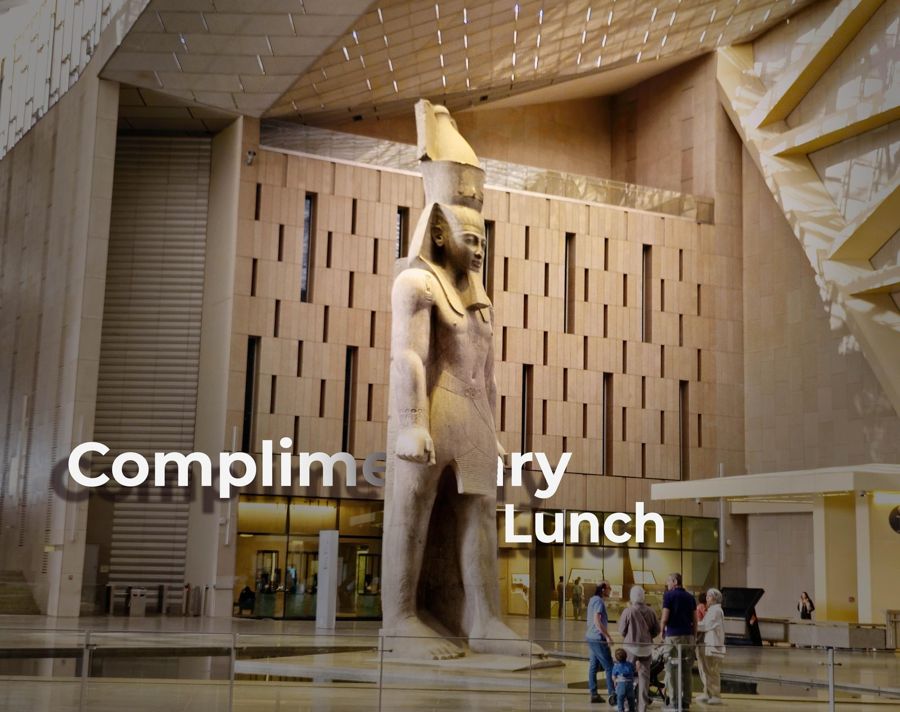
If you want to know how much time to plan for the Pyramids of Giza, since the end of 2025 you have to make an additional decision: the museum next door.
The Grand Egyptian Museum is two kilometers away, and it's not an afterthought. For the main galleries, at least three to four hours are recommended; if you want to see it at leisure, plan more. That means the museum takes about as long as the plateau itself.
There's also a regulation that rules out spontaneous add-ons. After the rush of the first weeks, when 27,000 people came in one day and the house closed early, the administration introduced fixed entry time slots. Since mid-November 2025, the ticket must be booked in advance for a specific slot, and you're expected to show up for that slot. The introduction of quotas was not uncontroversial, but it didn't change the fact that it applies. The currently offered times: 9, 11, 13, 15, 17, and 19 o'clock, each as a two-hour slot.
For time planning, that means three things. First, a combined day is a full day, realistically nine to ten hours door-to-door. Second, it's no longer flexible because a booked slot fixes the afternoon. And third, the order is thus predetermined: plateau in the morning, museum in the afternoon, because the site closes earlier.
If you really want to see both and have two days, you should separate them. That doesn't cost an extra trip because the two destinations are next to each other, and it's the difference between seeing and ticking off.
Two special cases
Two special cases remain, and both are more common than the standard answer suggests.
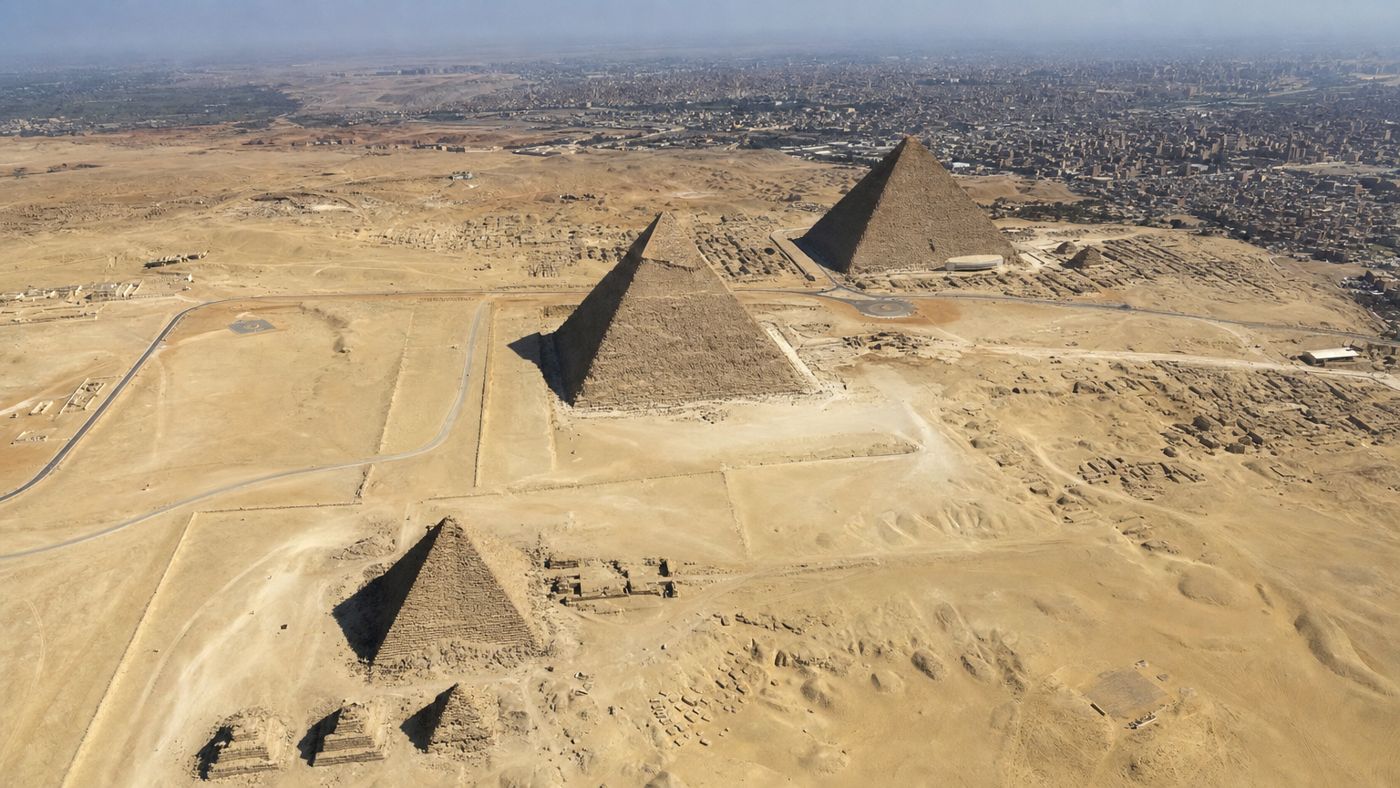
The first is the fixed time frame. If you're between two flights, coming from a cruise ship, or assigned a time slot in a group tour, you don't have a choice. For this case, there's a short version that works: main gate, shuttle to the viewpoint, twenty minutes there, shuttle to the Sphinx, twenty minutes on the terrace, exit at the eastern gate. That takes just under ninety minutes on the site, covers the two views people come for, and doesn't miss anything that would be reachable in that time. You skip the interior in this version without hesitation.
The second special case is the opposite. If you have several days in Cairo, you shouldn't think about how to fit everything into one morning, but rather go twice briefly. Two mornings of three hours each clearly beat one day of six hours, for three reasons: both times it's cool, both times it's empty, and the second time you already know where you want to go. The ticket is valid for one day each, so a second entrance fee applies, and for most people that's the best extra cost of the whole stay.
A word on the question behind both special cases: How long does attention last? Experience shows it's much shorter than the travel time suggests. The site offers three large monuments that are similar, and after the second, a certain saturation sets in. If you factor that in, you plan the Sphinx deliberately at the end and not at the beginning, because it looks different from everything before and wakes up attention once more.
What you should never do in any version: plan the afternoon in summer on the site. The calculation looks good on paper but doesn't work at thirty-five degrees without shade.
Frequently asked questions
How long does the visit on the site itself take?
Three to four hours for the three monuments, the viewpoint, and the Sphinx. Briskly, it can be done in two; with an interior, add about forty-five minutes.
And door-to-door?
From a hotel in central Cairo, six to seven hours. If you stay within walking distance, you save about an hour and a half of that.
Is half a day enough?
Yes, for what most people come for. A full day is only worth it with the valley temple, the cemeteries, or a second interior.
Can the plateau and the museum fit into one day?
Yes, but it becomes a full day of nine to ten hours, and the museum requires a pre-booked time slot.
What can you do in ninety minutes?
Viewpoint and Sphinx, each reached by shuttle. Those are the two views people come for.
Is a second visit worth it?
If you have the days, yes. Two short mornings are more pleasant and more productive than one long day, but they cost two entrance fees.