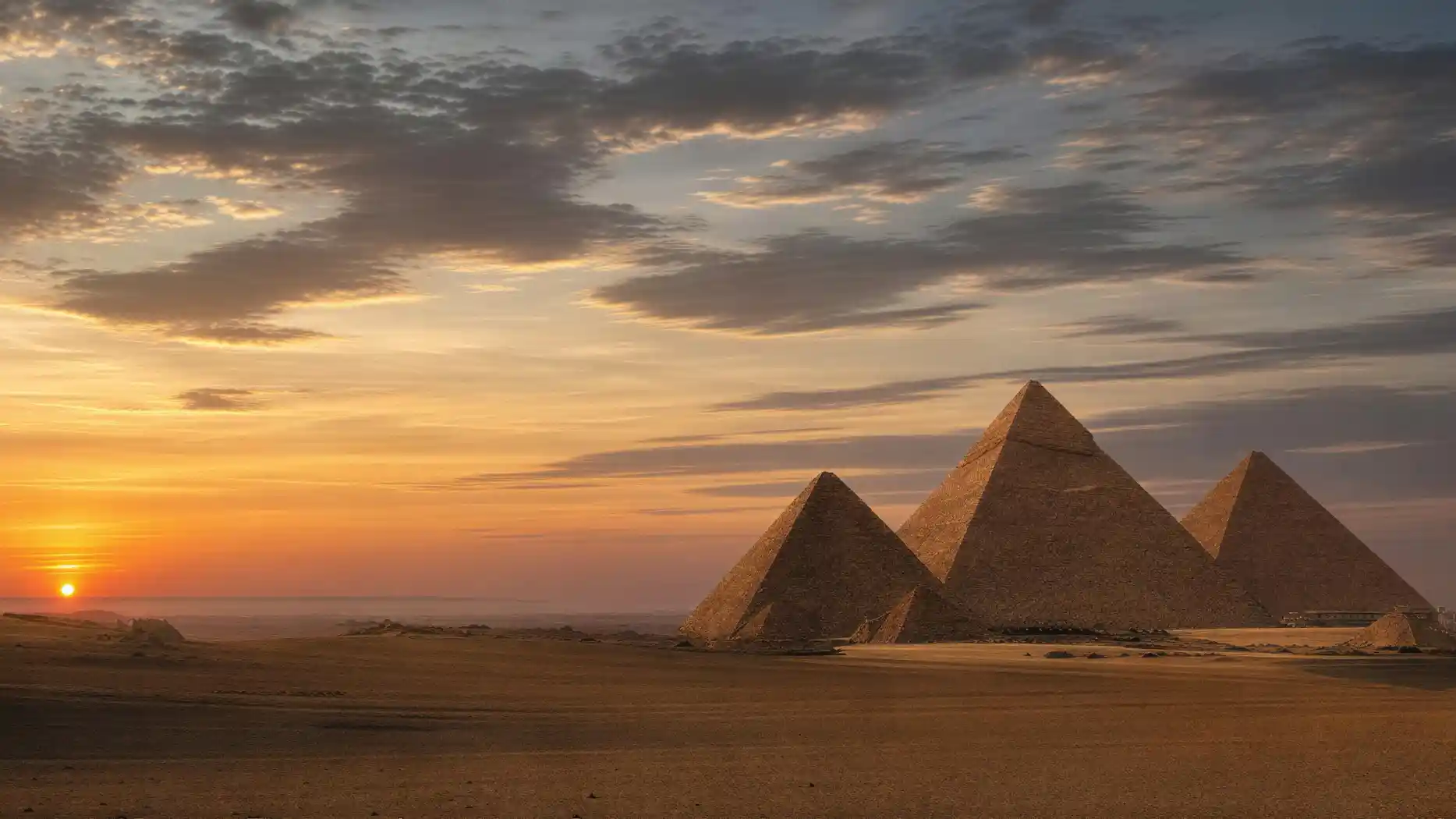
Alternative explanations for this site circulate not as a collection of arguments but as a collection of names. Anyone who reads into them stumbles not over theories but over people: a psychic from the 1930s, a British author, a Serbian-American inventor, a podcaster, and, since early 2026, an independent researcher from Barcelona.
This page is therefore organized as a register of names. For each name, it states what was actually claimed, what is supported by evidence, and what is not. The distinction matters more than the judgment: some of these people never claimed what is attributed to them, and in one case the attribution is entirely fabricated.
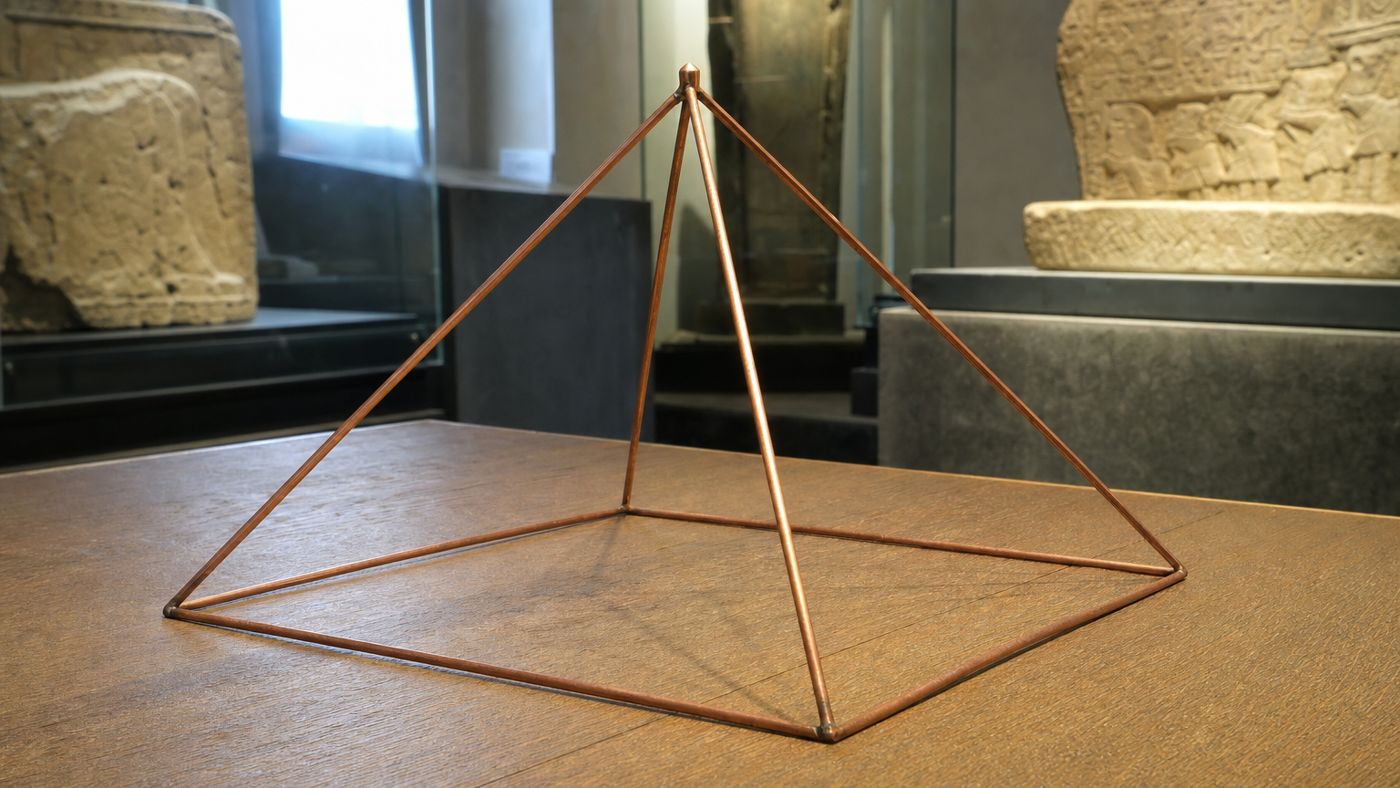
At the start, however, stands not a name but an object, because that is what people search for most often. Copper pyramids modeled on Giza are sold as home accessories and wellness devices, in sizes from palm-sized to walk-in structures, and the advertising promises effects ranging from better sleep to sharper razor blades.
So in order: first the pyramid power and its surprisingly well-documented prehistory, then the four names, then the most recent case. If you only want to know whether the shape has any effect, you can stop after the next section.
Does the shape work? Where the idea comes from
The notion that the shape itself has an effect is younger than you might think and can be traced back almost without gaps.
It begins in the 1930s with a French hardware dealer who claimed that meat does not spoil in a cardboard pyramid model. After the war, a Czechoslovak took up the idea and in 1949 actually filed a patent for a pyramid-shaped device for sharpening razor blades. So there really is a patent document for this promise; it is often cited and is the best evidence that a patent says nothing about efficacy, only about the novelty of a design.
The idea became popular in the West in 1970 through a book by two journalists about alleged parapsychological research in the Eastern Bloc. That started the wave that continues to this day, with models made of copper tubing.
It was also tested, in the 1970s, under controlled conditions. Meat, plants, and razor blades were examined, each inside and outside such frames. The summary review by a skeptical magazine of these experiments found no differences between pyramid and control, including microscopic examination of blade edges.
So the question of the shape is answered. A copper frame is a copper frame. If you find one beautiful, set it up; the connection to the Giza Plateau exists only in the name.



Guided tour with Egyptology background
- Questions like those on this page can be clarified on site in minutes, because you can see the comparison structures.
- German-language tour, pickup, and plateau entry included according to the provider.
- Three to seven hours, depending on the variant chosen.
- Free cancellation up to 24 hours before, according to the provider.
Who claims what
The names under which the popular narratives circulate, and the state of the evidence.
| Name | Attributed claim | What can be verified |
|---|---|---|
| Edgar Cayce | Atlantis refugees placed a chamber with inscribed tablets beneath the Sphinx | The statements exist as transcripts of trance sessions from the 1930s. Nothing was found; the predicted discovery period passed without result. |
| Graham Hancock | An advanced Ice Age civilization passed on its knowledge | The books exist and are widely distributed. Archaeological evidence for such a civilization is lacking. |
| Nikola Tesla | The pyramids were power plants for wireless energy transmission | No known Tesla statement about pyramids. The attribution arose later from his actual work on wireless energy. |
| Joe Rogan | Spreads doubt about the conventional dating | A talk format that hosts such theories. He himself usually makes no original claim. |
- Attributed claim
- Atlantis refugees placed a chamber with inscribed tablets beneath the Sphinx
- What can be verified
- The statements exist as transcripts of trance sessions from the 1930s. Nothing was found; the predicted discovery period passed without result.
- Attributed claim
- An advanced Ice Age civilization passed on its knowledge
- What can be verified
- The books exist and are widely distributed. Archaeological evidence for such a civilization is lacking.
- Attributed claim
- The pyramids were power plants for wireless energy transmission
- What can be verified
- No known Tesla statement about pyramids. The attribution arose later from his actual work on wireless energy.
- Attributed claim
- Spreads doubt about the conventional dating
- What can be verified
- A talk format that hosts such theories. He himself usually makes no original claim.
The table evaluates not the people but only the verifiability of the statements attributed to them.
Edgar Cayce and Graham Hancock
Now to the names. Edgar Cayce and the Giza pyramids belong together because almost all later narratives trace back to him. The American, who gave information in a trance state, spoke in the 1930s of refugees from Atlantis who had built a chamber beneath the Sphinx containing thirty-two stone tablets, and dated the site to about ten and a half thousand years before our era.
What is remarkable about this case is that it was testable. Cayce named a period in which the chamber would be found. The period passed, nothing was found, and the search was co-financed for years by the foundation that administers his work. A shaft grave nearby was fully investigated and turned out to be a tomb.
This course of events is why the narrative lives on to this day and at the same time why experts do not pursue it further. A prediction that does not come true becomes, in science, an argument against the assumption. In this environment, it is instead shifted: the discovery is said to be imminent but has been withheld. That immunizes the claim against any testing, and at that point it ceases to be a research question.
Graham Hancock and the Giza pyramids represent the more modern version of the same basic idea, without clairvoyance and with different vocabulary. The British author has argued since the 1990s that an advanced culture of the last Ice Age perished and passed on its knowledge to later peoples. His books have sold millions, his lectures are well attended, and the scholarly world has been contradicting him for just as long.
The objection is not that the thesis sounds far-fetched, but that a civilization of this kind would have to leave traces that could be found: settlements, tools, refuse, graves. Exactly that is missing. A culture that leaves nothing behind except knowledge in the minds of others is not archaeologically testable, and so the discussion ends not in dispute but outside the discipline.
Two names where the attribution is the problem
Two names belong in a separate category because the attribution itself is the problem.
Nikola Tesla and the Giza pyramids appear together so frequently in videos and articles that one might assume a documented connection. There is none. Experts who have studied his work for decades know of no statement by him about pyramids, neither in writings nor in interviews. What exists is a 1905 patent for transmitting electrical energy through the natural medium, in which pyramids do not appear. The connection was made later by conflating his actual work on wireless energy with the shape.
This can be checked without specialized knowledge. Tesla's writings, lectures, and patents are fully catalogued and publicly accessible, and indexes of his publications are available online. Anyone looking for a source for the pyramid claim will find none in these indexes, and anyone wanting to test a video claim only needs to ask for the reference. It is usually not provided.
This is an instructive case because it shows how easily a claim borrows authority. A famous name does not make a thesis better, but it makes it quotable, and from then on it circulates without anyone checking the source.
Joe Rogan and the Giza pyramids, in turn, stand for the channel of dissemination, not for a claim. The format is a multi-hour conversation in which guests present their positions at length. What is missing is not seriousness but contradiction: a conversation is not a testing procedure, and the length of a contribution says nothing about its reliability. Anyone who first hears a thesis there has heard it, not tested it.
The 12,000-year headline of 2026
That leaves the most recent case, which made headlines in early 2026. The Giza pyramids are 12,000 years old, was the summary that went around the world.
Behind it is an independent researcher affiliated with a university in Barcelona, who in a short, non-peer-reviewed paper combines three arguments: the precision of the construction, the absence of mummies and grave goods in the three main pyramids, and the weathering marks on the Sphinx, which some interpret as rain erosion.
Each of these arguments has a well-known counterargument. Precision demonstrates skill, not age, and the development toward it can be traced step by step in the older structures south of Giza. The absence of burials demonstrates looting, which is documented for this site since antiquity. And the interpretation of the weathering has been disputed for decades, with salt weathering and wind as possible causes alongside rain.
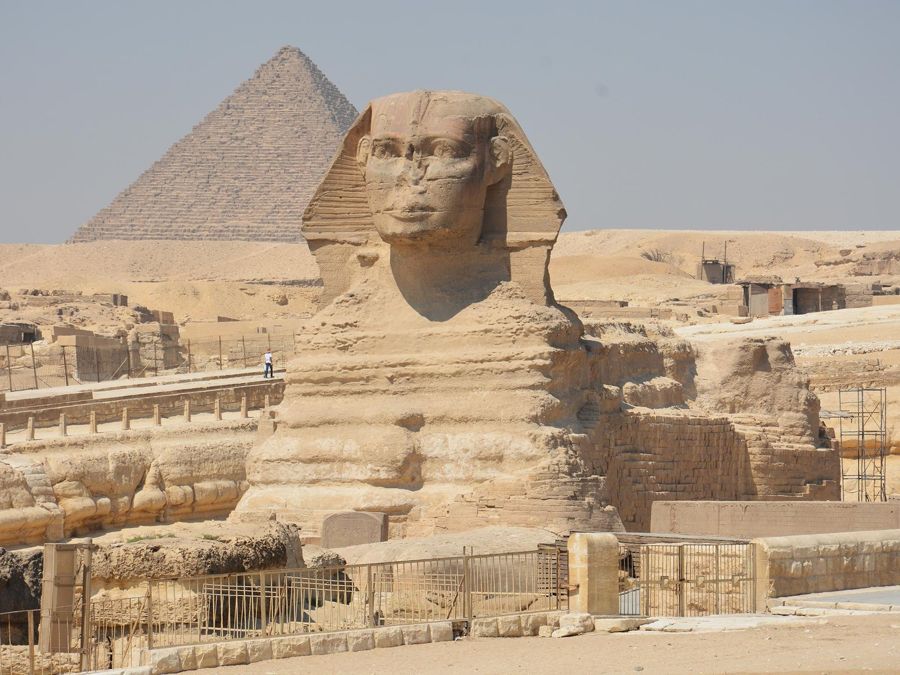
A note on the Sphinx weathering is worthwhile because it is the standard argument of this entire family of theories. The figure is carved from the bedrock, and this rock consists of layers of very different hardness. Soft layers recede faster than hard ones, and that produces exactly the wavy profile that looks like rain channels in photos. Whether rain also played a role is open; that rain alone explains the patterns is not.
But the decisive point is another, and it applies to all proposals of this kind. An earlier dating would have to fit not only the stones but also everything else: the administrative papyri, the workers' settlements, the radiocarbon dates of mortar remains, the king lists. A thesis that explains only one detail while leaving a dozen other findings unexplained is not a better explanation but a smaller one.
See the comparison structures for yourself. Most of these theories thrive on viewing Giza in isolation; if you stay a few days, you will see the older stages of development to the south and will no longer need a lost high culture. Three tours that cover this:
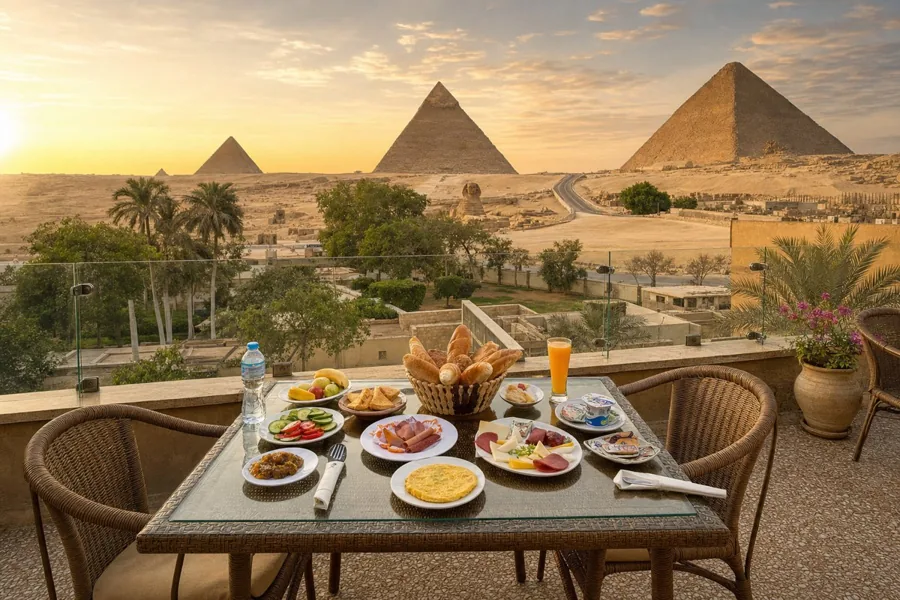 At the Sphinx
Giza Pyramids View Inn
- Good breakfast
- Airport shuttle
- Two restaurants
- 24-hour reception
- Free Wi-Fi
For those who want to see the Sphinx from their breakfast chair
 Most reviewed
Great Pyramid Inn
- Fabulous breakfast
- Rooftop terrace restaurant
- Bar
- Airport shuttle
- 24-hour reception
Most who want to stay in the neighborhood
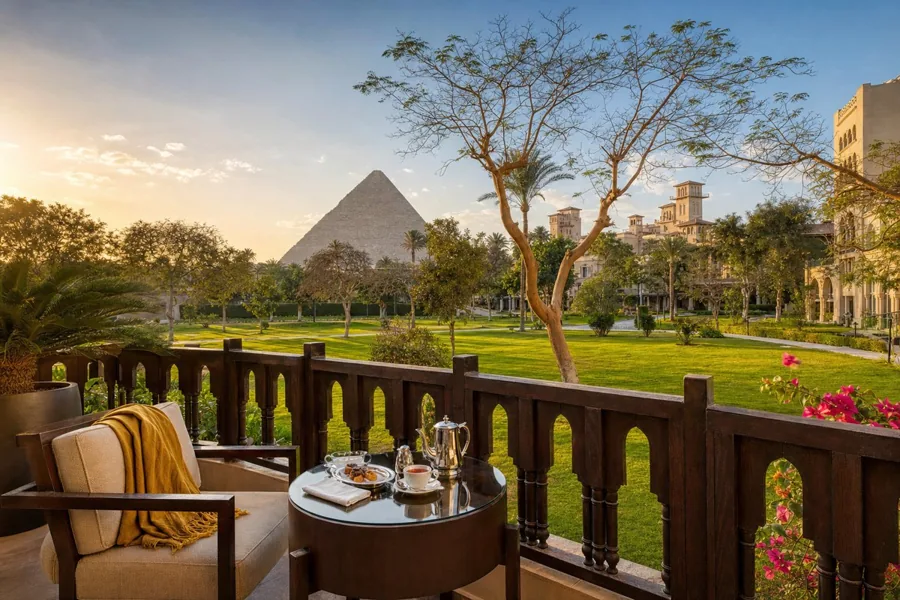 Garden & pool
Marriott Mena House
- Excellent breakfast
- Outdoor pool
- Spa and wellness center
- Three restaurants
- Fitness center
For those who want space, garden, and pool instead of a rooftop terrace
Frequently asked questions
Do copper pyramid models work?
According to controlled experiments from the 1970s, no. Neither with food, nor plants, nor razor blades was there a difference compared to the control.
Does the patent for the blade sharpener really exist?
Yes, filed in 1949 in Czechoslovakia. However, a patent certifies the novelty of a design, not its efficacy.
Did Tesla write about the pyramids?
According to current knowledge, no. Experts who study his work know of no such statement. The connection was made later.
Was the chamber beneath the Sphinx found?
No. Despite decades of searching, including with modern survey methods, nothing matching the description was found.
Could the pyramids be much older?
There is no reliable evidence for that. An earlier dating would also have to fit the papyri, settlement findings, and radiocarbon dates, and it does not.
Why do experts disagree so uniformly?
Because the findings fit together. Contradiction arises where a thesis explains individual observations and ignores the rest.