Accessibility in Giza is at an odd point. The site is now more accessible than ever before in its history as a visitor destination, and at the same time, you can hardly find any documentation about it.
The reason for the first is the renovation since 2025. Many visitors perceive it as a downgrade: no more cars on the site, a shuttle instead of walking on your own, fixed paths instead of free movement. For someone in a wheelchair, this exact bundle means something different. Paved paths, an air-conditioned vehicle between the main points, and a step-free entrance are the three things that were missing before.
The reason for the second is a documentation problem. The official site page lists opening hours, prices, and parking fees, but not a single word about accessibility. What concrete information circulates comes from travel information, and some of it cannot be verified.
This page therefore consistently distinguishes between three things: what is proven, what is reported, and what is certainly excluded. Anyone planning a visit where a mistake cannot be compensated by a bit more effort needs this distinction.
- Interiors of the Pyramids
- Excluded. None of the three, not even partial sections.
- Main Entrance and Visitor Center
- Step-free, since the new construction in the southwest
- Paths Between the Main Points
- Paved, created as part of the renovation
- Last Meters to the Monument
- Unpaved, sand and rubble
- Shuttle Vehicles
- Mixed fleet; some with ramp, on request
- Boarding
- Ramp, steep due to low curb
- Access with Own Vehicle
- Possible, but must be requested in advance
- Discounted Entry
- Not in the price list, but reported
What the Renovation Actually Improved
First, what can be proven, because it forms the basis of any planning.
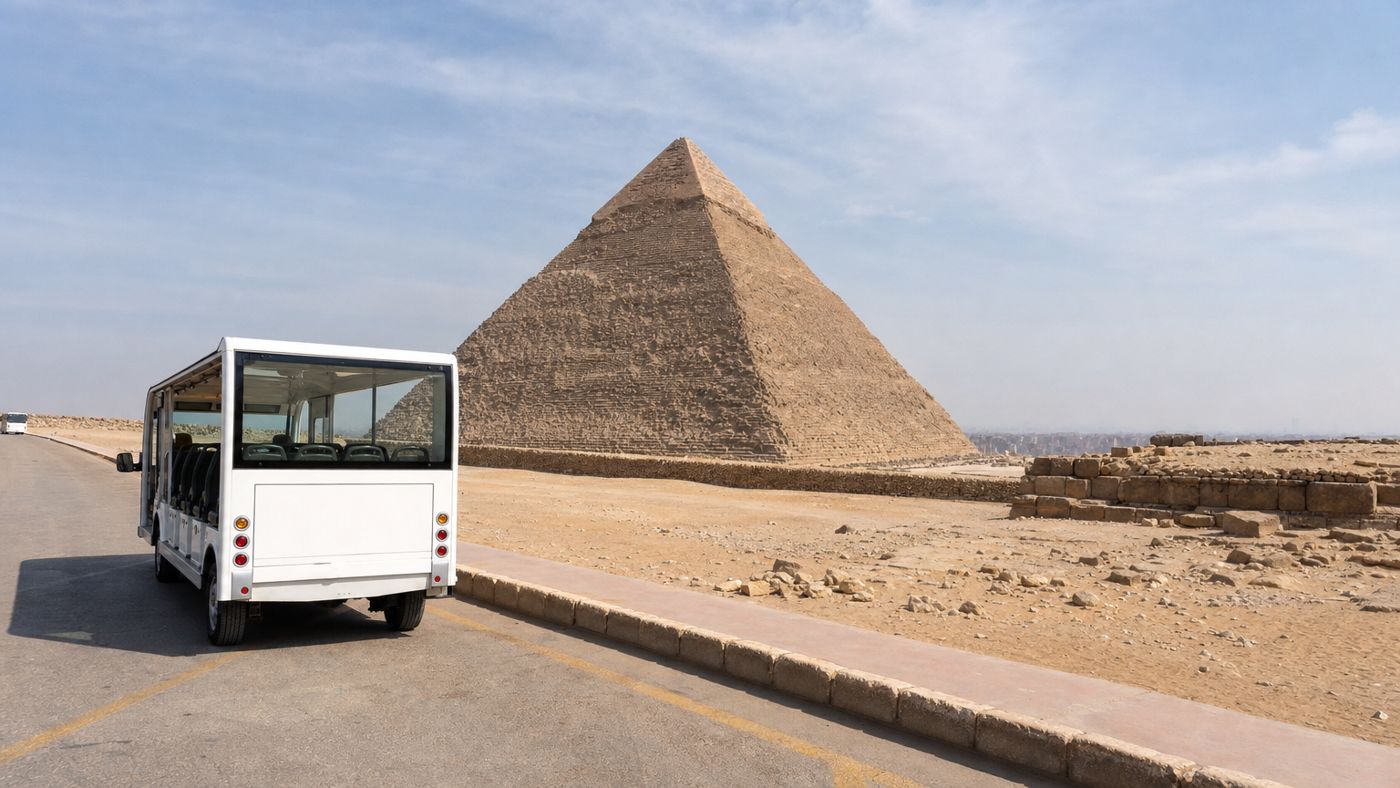
The renovation has completely changed the traffic management. Private vehicles and tour buses no longer drive onto the site. Instead, visitors transfer at the visitor center and ride air-conditioned electric buses between the three great pyramids and the Sphinx. At the same time, as noted in the Smithsonian coverage of the redevelopment, roads and paths were paved to facilitate access to the monuments.
That is more than it sounds. Anyone who knows the site before 2025 remembers an open sand area where tour buses and taxis drove and where there were neither continuous paths nor reliable reference points. A wheelchair could only get around there with a vehicle, and that vehicle was a taxi in the dust.
Then there is the entrance itself. The new main entrance in the southwest with the visitor center is step-free, which was not the case at the old gate. Ticket machines, security check, restrooms, and the starting point of the shuttle are all close together there, so the path from arrival to the first vehicle is short.
What emerges from this is an unusual recommendation: The part of the renovation that other visitors complain about is the most valuable for this group.
Where the Limits Lie
Now the limits, and the first is clear.
No interior is accessible. Neither the largest pyramid nor the other two, and there is no partial section that could be navigated. Access is via narrow, ascending passages that force a bent posture, with no alternative and no staff that could intervene along the way. This is not a lack of equipment that could be retrofitted, but the building substance itself. Anyone expecting this to change will wait in vain.
The second limit is less absolute and more important in everyday life: The paving ends before the monument. Between the shuttle stop and the pyramid base lies unpaved ground, sand and rubble, partly with slopes. How far this is in individual cases depends on the stop. An active wheelchair struggles there, an electric wheelchair with narrow tires also, and companions regularly underestimate the distance because it looks short on a map.
The Sphinx is the point where the information diverges the most. Level viewing platforms with ramp access are reported; this cannot be proven from any official source. Therefore, plan with what you can see from the paved path, and treat everything else as a possible bonus.
The third limit includes the things that hardly anyone asks about and that still decide the day. Restrooms are at the visitor center, and this building is step-free. Whether there is an accessible stall there and whether the other restrooms on the site are equally equipped is not published. Likewise, it is unknown whether wheelchairs are available for loan at the entrance or whether staff will help if needed. Both exist at many large sites; here it is simply not documented. Therefore, plan as if neither existed, and count the opposite as a pleasant surprise.
And a note that has nothing to do with wheelchairs but belongs here: For families with strollers, the same division applies. The stroller can go on the paths, but not everywhere.
Two tours that the provider explicitly marks as accessible for wheelchair users and that offer a German-speaking guide. The marking comes from the portal, not from us; still, clarify the specific process with the organizer in advance.
 Private, with Pickup
Plateau and Museum in One Day, with Pickup
- Plateau entry
- English-speaking guide
- Hotel pickup
- Lunch
- Free cancellation up to 24 hours before
For those who want to combine the documented accessible museum part with the site
 Most booked
Long Day with Saqqara and Dahshur, Private Transfer
- Plateau entry
- English-speaking guide
- Hotel pickup
- Lunch
- Pyramid interior
- Free cancellation up to 24 hours before
For those who prefer to solve the transport question once rather than at every point
The First Report from a Wheelchair User
Now to the part that really matters. For a long time, this section stated that nothing could be proven on the decisive questions. That has changed since February 2026: There is now a detailed first-person report from a wheelchair user who traveled the site. It does not replace an operator statement, but it is the first usable source at all, and it answers the most important question.
First, the shuttle. The fleet is mixed. Not every vehicle is wheelchair-accessible, and the staff will bring a suitable one on request. Boarding is via a ramp; because the curb at the stops is low, this ramp is steep, which the report explicitly criticizes. That is the answer to the core question, and it is fundamentally good: There are vehicles that can be boarded without steps. But expect to wait for the right one, and expect help with pushing.
What still no one describes is the interior: whether there is a space where a wheelchair can stand and be secured. Whether the vehicle has a secured standing area is not described in any source. The fact that the staff specifically fetches a certain vehicle suggests that the vehicles differ inside, but that is a conclusion, not an observation, and we treat it as such.
Access, Entry, and the Point That Changes Everything
Second, access. For wheelchair users and guests with limited mobility, driving your own car onto the inner road can be approved, as can private golf carts and tour groups of about 25 people or more. The decisive word is one: in advance. This is applied for beforehand, not asked at the gate. That vehicle access is a regular category at all can be proven, because the official site page lists a separate vehicle ticket with tiered rates for cars, minibuses, and buses. The exception must be applied for in advance and cannot be obtained at the gate. Do not let anyone at the gate make verbal promises on which your whole day depends.
Third, entry. The official price list of the ministry only knows four categories for the site, and a discount due to disability is not one of them. From February 2026, however, it is reported that visitors with disabilities get in at a reduced rate. Both can be true if the ticket counter follows a rule that is not in the list. Ask about it, but budget for the full fare.
And a fourth point, which appears only in this one report and which shifts the answer to the initial question. There are walkways around the monuments, but from the inner road there is no paved path up to them; whoever wants to go up rolls over sand. At the panorama point, the stop is accessible and there is dining; at the Sphinx, the main path was under construction in February 2026, so only the view from the road remained. The honest answer to "can I do it independently" is therefore neither yes nor no, but: The path network yes, the last twenty to fifty meters to the monument no.
The practical consequence remains the same: Clarify access and vehicle in writing before your trip, either through the operator of the visitor operation or through a tour operator who takes responsibility. A written confirmation here is not mistrust, but the only form of planning security that exists.
Sorted by Evidence
The same points, ordered by how certain they are. The middle column is the one missing from most travel information.
| Point | Status | What This Means for Planning |
|---|---|---|
| Interiors | Excluded | Do not plan for, not even partially |
| Step-free entrance and visitor center | Proven | Use as the starting point of the day |
| Paved paths between the main points | Proven | Plan route along the paths |
| Air-conditioned shuttle at regular intervals | Proven | Factor in as a retreat from the heat |
| Boarding the shuttle via ramp | First-person report 2026 | Wait for the suitable vehicle, plan for assistance |
| Standing area and securing in the vehicle | Not documented | Clarify in writing in advance |
| Access with own vehicle after registration | Reported; vehicle ticket officially proven | Apply in advance, not at the gate |
| Access from the road to the walkways | First-person report 2026: only over sand | Do not plan the last meters |
| Ramps and platforms at the Sphinx | Reported, not proven | Treat as a possible bonus |
| Discounted entry | Not in the price list, but reported | Ask about it, budget for the full fare |
- Status
- Excluded
- What This Means for Planning
- Do not plan for, not even partially
- Status
- Proven
- What This Means for Planning
- Use as the starting point of the day
- Status
- Proven
- What This Means for Planning
- Plan route along the paths
- Status
- Proven
- What This Means for Planning
- Factor in as a retreat from the heat
- Status
- First-person report 2026
- What This Means for Planning
- Wait for the suitable vehicle, plan for assistance
- Status
- Not documented
- What This Means for Planning
- Clarify in writing in advance
- Status
- Reported; vehicle ticket officially proven
- What This Means for Planning
- Apply in advance, not at the gate
- Status
- First-person report 2026: only over sand
- What This Means for Planning
- Do not plan the last meters
- Status
- Reported, not proven
- What This Means for Planning
- Treat as a possible bonus
- Status
- Not in the price list, but reported
- What This Means for Planning
- Ask about it, budget for the full fare
"Proven" here means: verifiable in official information or in national reporting. "Reported" means: described multiple times, but without a verifiable source. "First-person report 2026" means: described by a person who appears by name and was there in a wheelchair in February 2026.
At the Museum, the Situation Is Reversed
Finally, a comparison that can change the planning of an entire day.
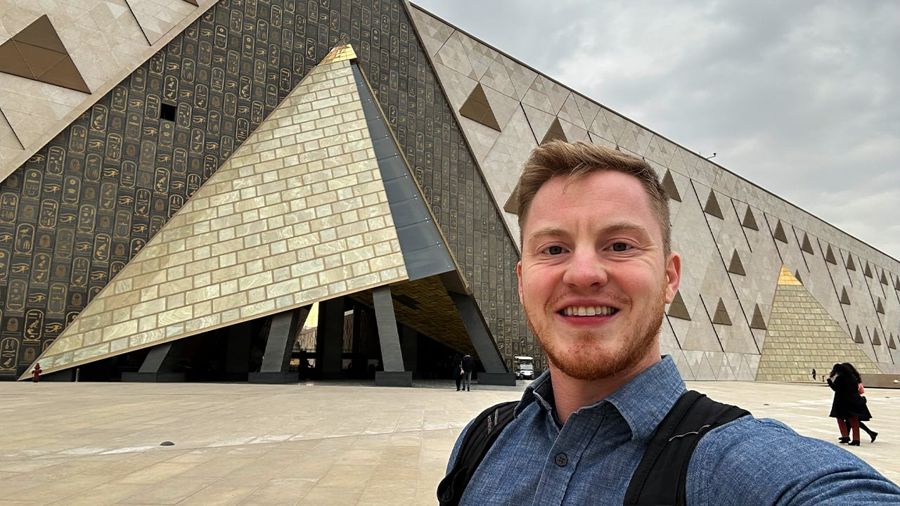
Two kilometers from the site stands the Grand Egyptian Museum, and there the situation is exactly reversed. It is a new building, and even before the opening, ramps, elevators, designated parking spaces, rest areas, and Braille signage were announced. The museum publishes its own information about this, while the administration of the site remains silent about its own facility.
For daily planning, this means: Put the strenuous, uncertain part first and the predictable part after. The site early in the morning, when it is cool and empty and you still have energy for detours. The museum afterwards, where elevator, seating, and restroom are always within reach. The other way around, the day turns out worse because the uncertain half then meets tired legs.
One point deserves special attention because it intertwines with everything else: the heat. On an open area without shade, you sit in a wheelchair longer in the sun than someone who keeps walking, and a metal frame gets hot in this environment. In addition, the way back to the exit has no shortcut. The air-conditioned shuttle is therefore not just transport, but the only reliable cool place on the site. If you plan for that, you plan the duration of your stay more realistically.
And if you stay overnight between the two, you save yourself the most difficult stage of all: the way through Cairo's traffic.
Accommodation within walking distance of the site. The search can be filtered by accessibility features, so the selection can be narrowed down before booking. Three properties that cover this:
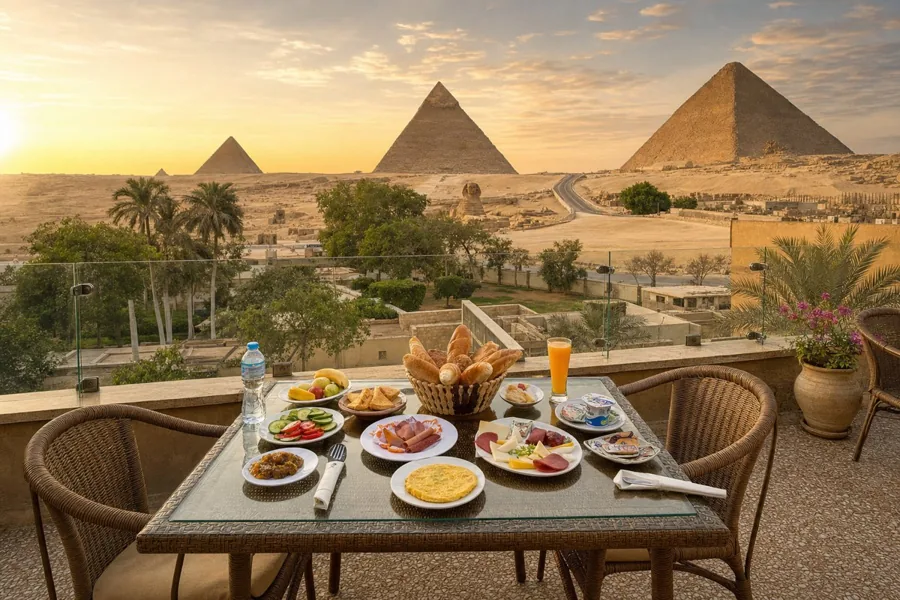 At the Sphinx
Giza Pyramids View Inn
- Good breakfast
- Airport shuttle
- Two restaurants
- 24-hour reception
- Free Wi-Fi
For those who want to see the Sphinx from their breakfast chair
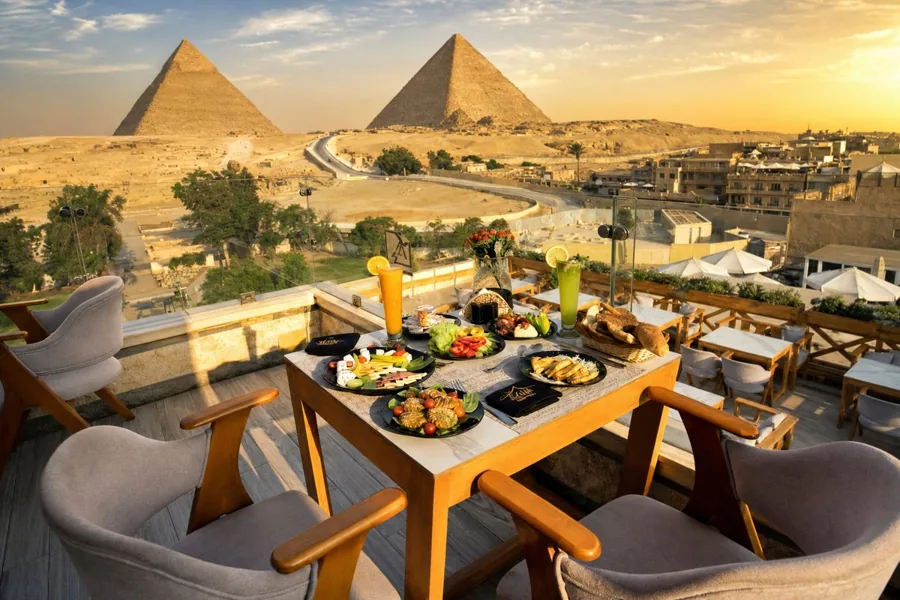 Most reviewed
Great Pyramid Inn
- Fabulous breakfast
- Rooftop terrace restaurant
- Bar
- Airport shuttle
- 24-hour reception
Most who want to stay in the neighborhood
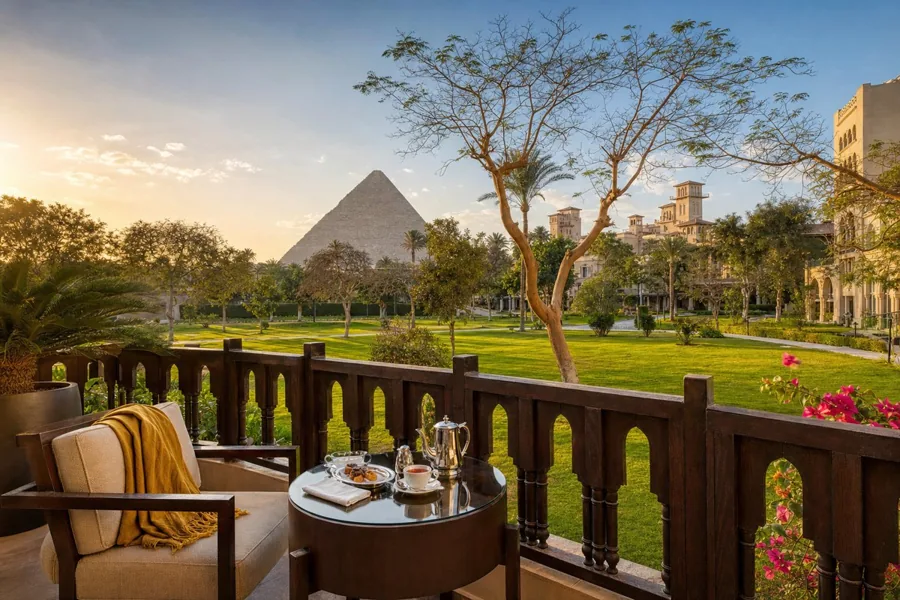 Garden & pool
Marriott Mena House
- Excellent breakfast
- Outdoor pool
- Spa and wellness center
- Three restaurants
- Fitness center
For those who want space, garden, and pool instead of a rooftop terrace
Frequently asked questions
Can I enter a pyramid in a wheelchair?
No. None of the three interiors is accessible, and there is no navigable partial section.
Can I get up to the pyramid in a wheelchair?
Up to the paved path, yes. The last meters to the monument are over sand and rubble.
Is the electric bus wheelchair-accessible?
That is not documented anywhere. Clarify it in writing before your trip, because the whole process depends on it.
Am I allowed to drive my own vehicle onto the site?
It is reported that this is possible after prior registration. It is not guaranteed, and no plan should rely on it.
Is there a discounted entry?
The official price list does not include one. Budget for the full fare.
What about a stroller?
The same picture: unproblematic on the paved paths, not off them.