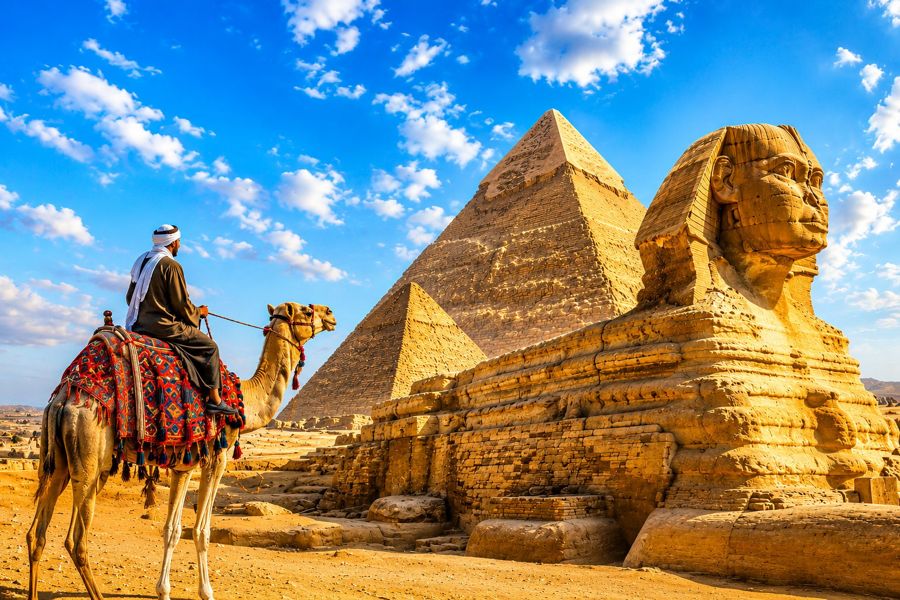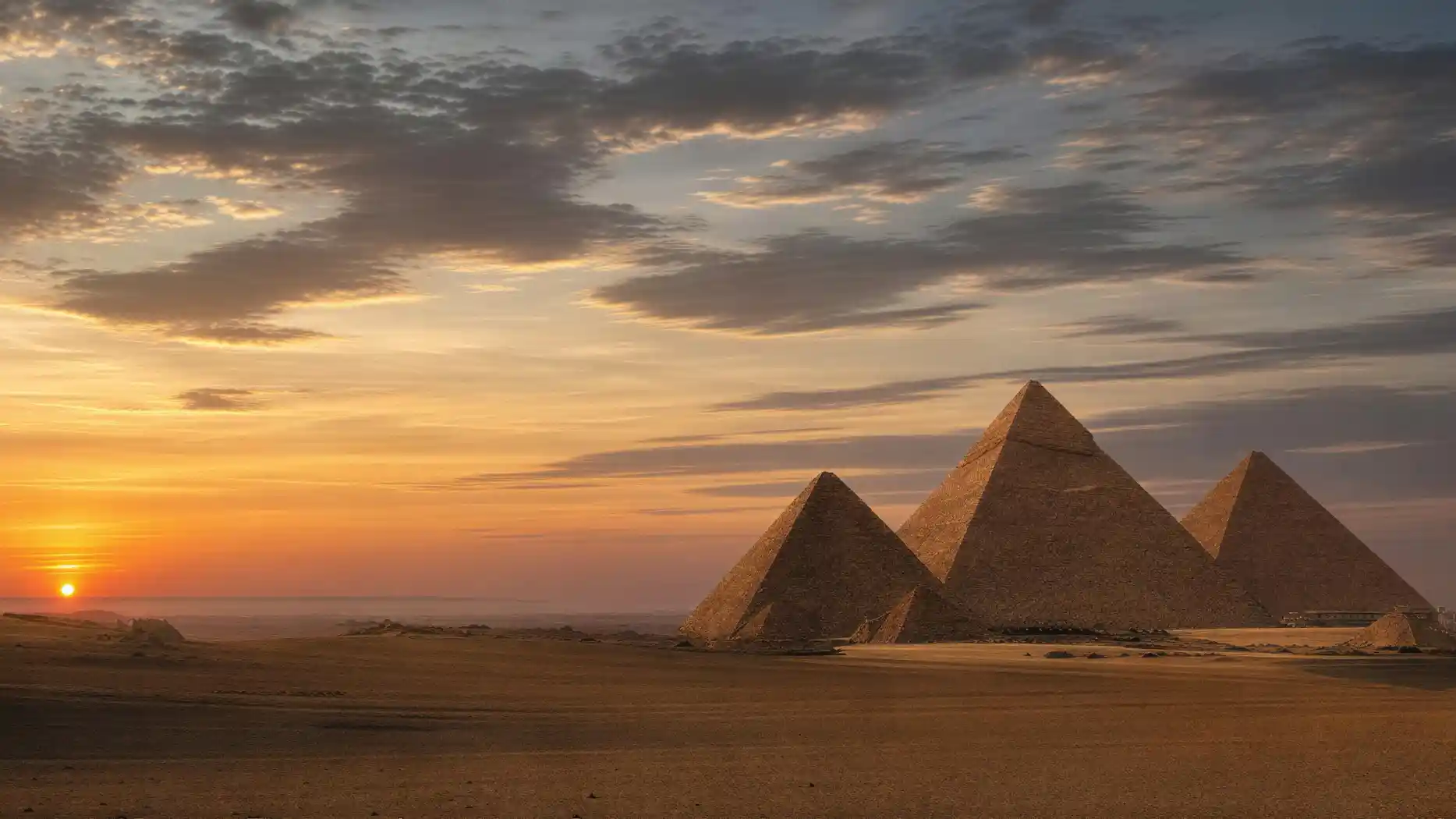
Concerts at the Pyramids of Giza are not a recent invention. The first rock band played there in 1978, and since then a list has emerged that reads like a cross-section of popular music over five decades.
That is the real difference from the electronic evenings that are currently being written about more. Those are new and frequent. Major concerts, on the other hand, have taken place here for almost fifty years, at irregular intervals, with long pauses in between, and those pauses tell their own story about the country.
Two things stand out immediately about this list. First, it is shorter than the venue's reputation suggests: In five decades, fewer than twenty major evenings have come together, which is less than a handful per decade. Second, it is unevenly distributed, with a sparse beginning and a noticeable clustering in recent years.
For travellers, the matter is double-edged. An evening of this kind is undeniably special, and the backdrop is not just an advertising claim. At the same time, the dates are rare, expensive, announced far in advance, and still not certain, as has been shown again recently.
Technically, the venue is anything but simple. There is no permanent stage, no grandstand, no power connection for a large-scale production, and no access road designed for semi-trailers. Everything a concert needs is brought in, built on sand, and taken down again afterwards, all around a visitor operation that continues to run during the day. What looks from the outside like the most obvious backdrop in the world is, for an organiser, one of the more elaborate venues.
This page lists who has played there, explains how the venue works as a stage, and says what to look out for when buying tickets.
Five Decades on One Stage
- 1978
An American rock band plays three evenings at the foot of the Sphinx, the last during a lunar eclipse, together with a Nubian oud player and a Nubian youth choir.
- 27 September 1979
Frank Sinatra sings in front of the Sphinx.
- New Year's Eve 1999
Jean-Michel Jarre gives a millennium concert with over a thousand participants.
- 2001
Sting performs with the Algerian rai singer Cheb Mami, then promoted as the region's first major concert.
- 28 March 2007
Shakira performs as part of a world tour.
- 2010
Three evenings in one year: Mariah Carey in May, Andrea Bocelli in September, Kylie Minogue in October in aid of a children's hospital.
- 2017 to 2022
Armin van Buuren, the Red Hot Chili Peppers, the Black Eyed Peas, Maroon 5, and Russ as the first solo rapper.
- 2025
Katy Perry at a closed performance, Tiësto with a three-hour set in December.
What the Concert List Reveals
This list, which is indebted to a detailed overview, is revealing for several reasons.
First, because of the gaps. Between 1979 and 1999, there were twenty years without a major international performance; between 2001 and 2007, another six. This has little to do with demand and much to do with politics, the security situation, and the state of tourism. The venue is always there; it is not always bookable.
The beginning of the series deserves its own mention because it looked so unlike the music business. The three evenings in 1978 were largely self-financed by the band, the audience was modest, and part of the programme was created together with local musicians. An official recording only appeared three decades later. It was therefore not a marketing project but an idea that someone actually followed through, and that is exactly why this date still stands at the beginning of every list.
Then, because of the density afterwards. Since 2010, dates have accumulated, and since 2021, hardly a year has passed without at least one. This coincides with the reorganisation of the visitor operation and an operator who explicitly earns from renting out the site. What was once a rare state occasion is now a business model.
And finally, because of the range. There has never been a music festival at the Pyramids of Giza in the sense of a multi-day programme with several stages, and that is no coincidence: the area is limited, permits are issued individually, and the setup is elaborate. What takes place are single evenings with one name on the poster, occasionally a two-day format. Anyone expecting a festival in the European sense is expecting the wrong thing.
Accommodation within walking distance of the event site. Concert evenings end late, and the journey back through the city afterwards is the most unpleasant part. Three properties that cover this:
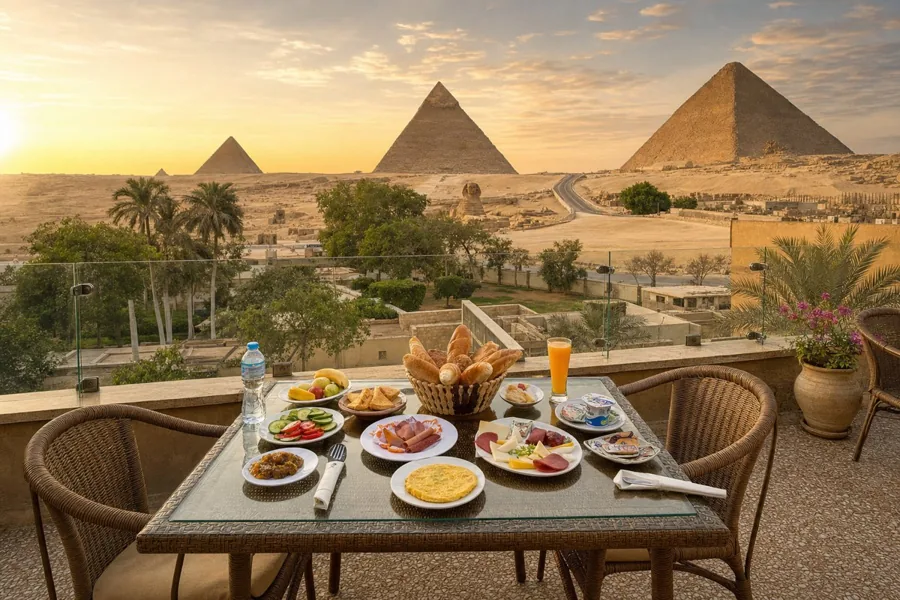 Vicino alla Sfinge
Giza Pyramids View Inn
- Ottima colazione
- Navetta aeroportuale
- Due ristoranti
- Reception 24 ore
- Wi-Fi gratuito
Per chi vuole vedere la Sfinge dalla colazione
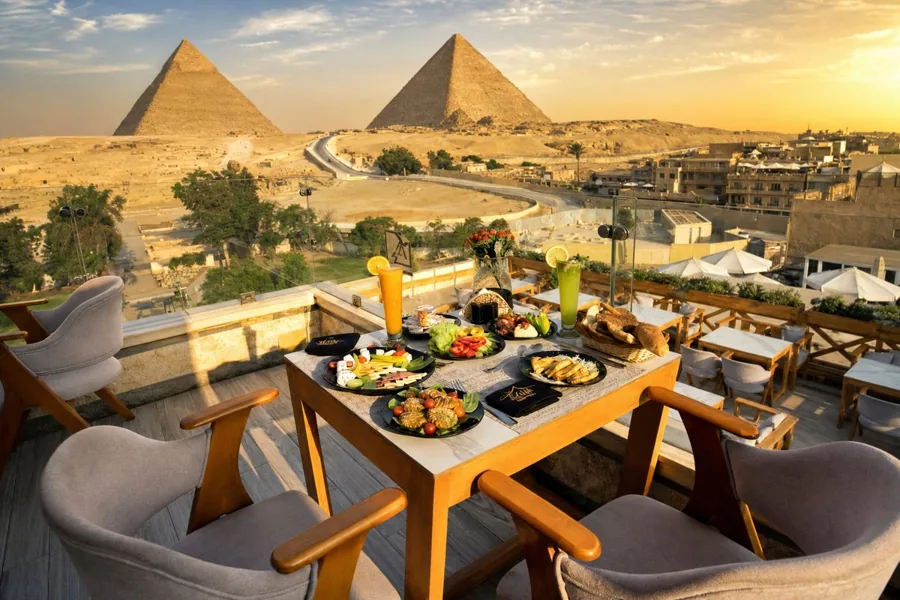 Più recensito
Great Pyramid Inn
- Colazione favolosa
- Ristorante sulla terrazza
- Bar
- Navetta aeroportuale
- Reception 24 ore
Per la maggior parte di chi vuole soggiornare nel quartiere
 Giardino e piscina
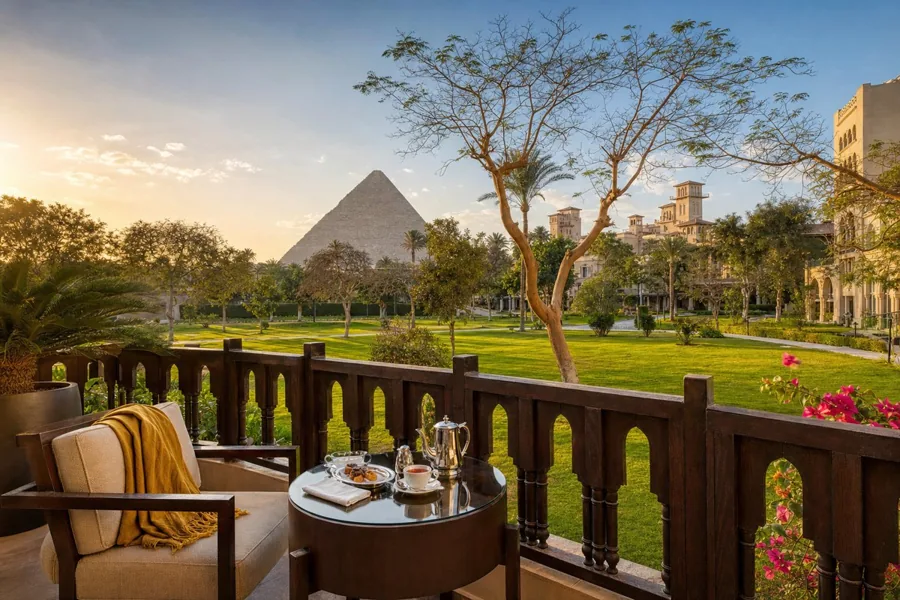
Marriott Mena House
- Colazione eccellente
- Piscina all'aperto
- Spa e centro benessere
- Tre ristoranti
- Centro fitness
Per chi cerca spazio, giardino e piscina invece della terrazza
Shakira Returns After Nineteen Years
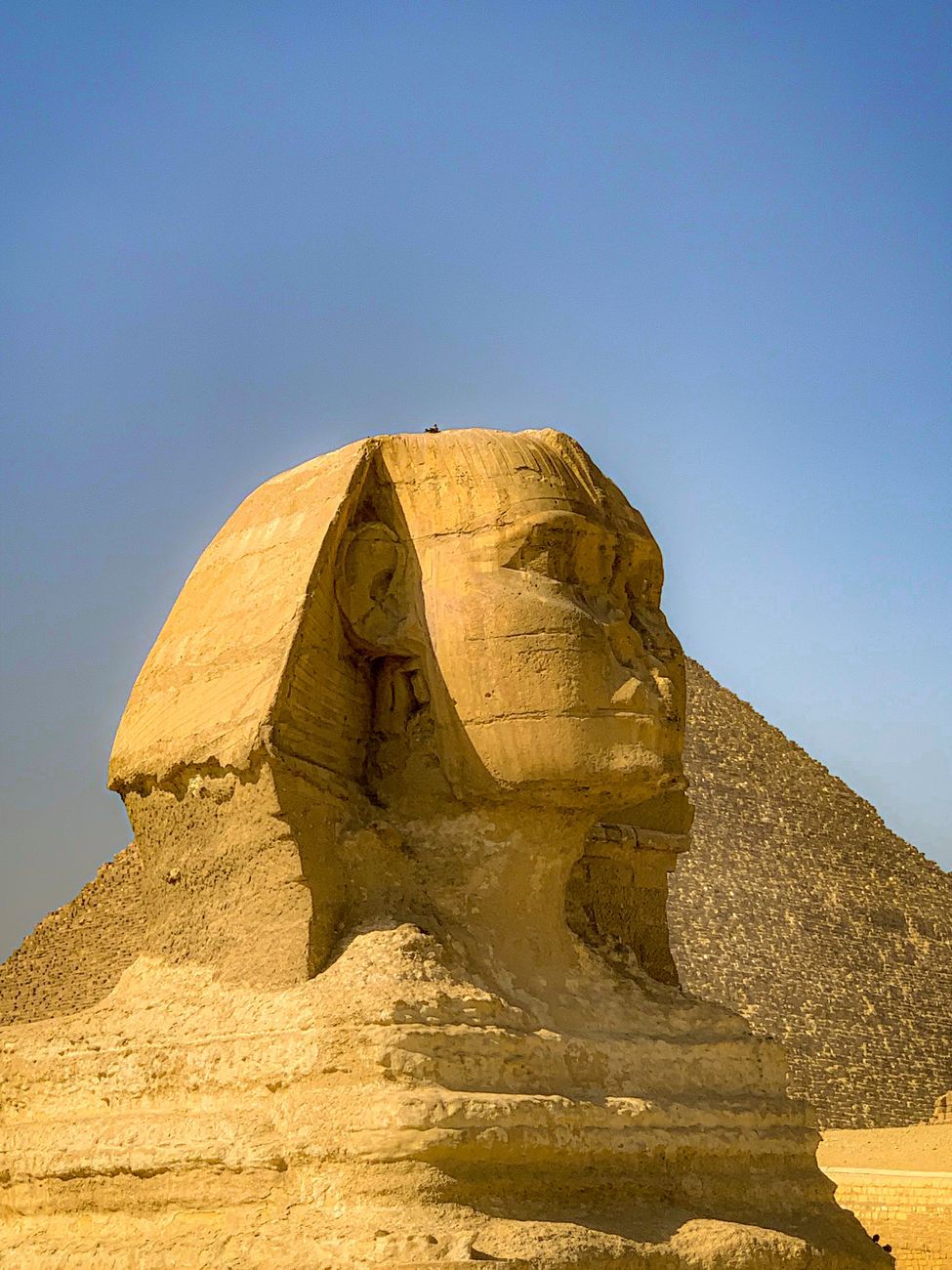
The most prominent current date is also a return. Shakira at the Pyramids of Giza has happened before, on 28 March 2007, and a second performance is announced for November 2026, a good nineteen years later.
What is remarkable about this is less the name than the history of the date. Originally, the performance was scheduled for spring 2026 and was postponed to late autumn; the organiser's side cited the situation in the region as the reason. Tickets from the first sales period remained valid.
Also interesting about this return is the gap. Nineteen years lie between the two dates, and in that time everything has changed except the backdrop: The main entrance is elsewhere, vehicles are no longer allowed on the site, a private operator runs the visitor business, and next door there is a museum that did not exist in 2007. The venue is the same; the operation around it is a different one.
That is precisely the lesson for anyone wanting to travel for such an evening. Dates at this venue depend on more factors than the artist's availability: on permits, on the political situation, on the logistics of a setup in the desert. Postponements and cancellations are not the exception here but occur regularly.
In practical terms, this does not mean one should stay away. It means that the trip has to work even if the evening falls through. Anyone who wants to go to Egypt anyway and takes the date along runs no risk. Anyone who flies solely for this reason does.
Who Decides on a Permit
How the Pyramids of Giza actually function as a venue surprises most people.
The Antiquities Authority is responsible for the site, a private company for the visitor operation around it, and a third body for the permit of a performance, namely the professional association of musicians. An organiser therefore has to open several doors, and each one can remain closed. Ultimately, tickets are sold by the organiser, not the site.
The stage is not in a fixed position. Depending on the size of the production, it is set up between the Sphinx and the monuments or further south on the open area where there is more space. In both cases, the audience sees the illuminated monuments, and in both cases, the view is part of the product. The setup takes days, as does the dismantling.
What a concert ticket does not include is a visit to the site. You enter a separated event area, not the excavation site, and a tour is not part of the evening. Whoever wants both needs two tickets and, ideally, two days.
There is also a limitation on visibility that disappears in marketing images. Depending on the setup, several hundred metres lie between the stage and the monuments. The pyramids thus stand illuminated on the horizon, not as a backdrop behind the band. In photos with a long focal length, this looks different because the optics compress the two together. Anyone arriving with the expectation of standing directly at the monument should correct it beforehand.
And one point that people in Central Europe do not think about: There is no permanent grandstand. Seats are erected seats, standing areas are sand, and both are noticeably cooler after sunset than the day suggests.

Private transfer around the clock from Cairo and Giza
The return journey after a concert at the plateau is the part that appears on no announcement: several thousand people leave a site at the edge of the desert at the same time. A pre-booked ride at a fixed time is the only precaution that still works then. Free cancellation.
How to Find Out What's Coming Up
This leaves the question of how one even finds out what is coming up. It is harder to answer than it should be.
There is no official overview of events at the Pyramids of Giza. The Antiquities Authority runs the site as an excavation site, not as a performance venue, and publishes no schedule. Dates are announced by the respective organisers, usually via the channels of the artists, and picked up by the international music press. German-language reports on this appear rarely and late.
In practical terms, this means: Anyone who does not stumble across it by chance has to search specifically for the name they are following anyway. For an undirected view, music journalism is more worthwhile than any travel site, also more than this one. Dates are announced with a lead time of a few weeks to months and are subject to the approval of the professional association of musicians.
Anyone who wants to know more precisely takes the opposite approach: not from the venue to the event, but from the artist to the venue. The artists' tour pages list their dates fully and currently, and a performance in Giza appears there with date and advance sales long before any travel site picks it up.
Two more notes that appear on no announcement. First, the tickets are priced internationally, not Egyptian, and are clearly above what a concert evening in Cairo otherwise costs. Second, the journey to the event on the concert day coincides with the usual traffic, and the last few kilometres to the site are regularly blocked on such evenings. Two hours of buffer time is not being overly cautious.
Domande frequenti
Do concerts take place there regularly?
Since 2010, several times per decade; since 2021, almost annually. Before that, there were sometimes twenty years between two major performances.
Where can one get tickets?
Exclusively from the respective organiser. There is no central body and no official schedule.
Is entry to the site included?
No. You enter a separated event area. For a tour, you need a regular entry ticket on another day.
Can dates be postponed?
Yes, and this happens regularly. Most recently, a performance announced for spring 2026 was moved to late autumn.
What should one wear?
Something warm in addition and sturdy shoes. You stand or sit on sand, and the temperature drops noticeably after sunset.
Has there ever been a multi-day festival there?
Not in the European sense. What takes place are single evenings, occasionally on two consecutive days.